Against Democratic Planning
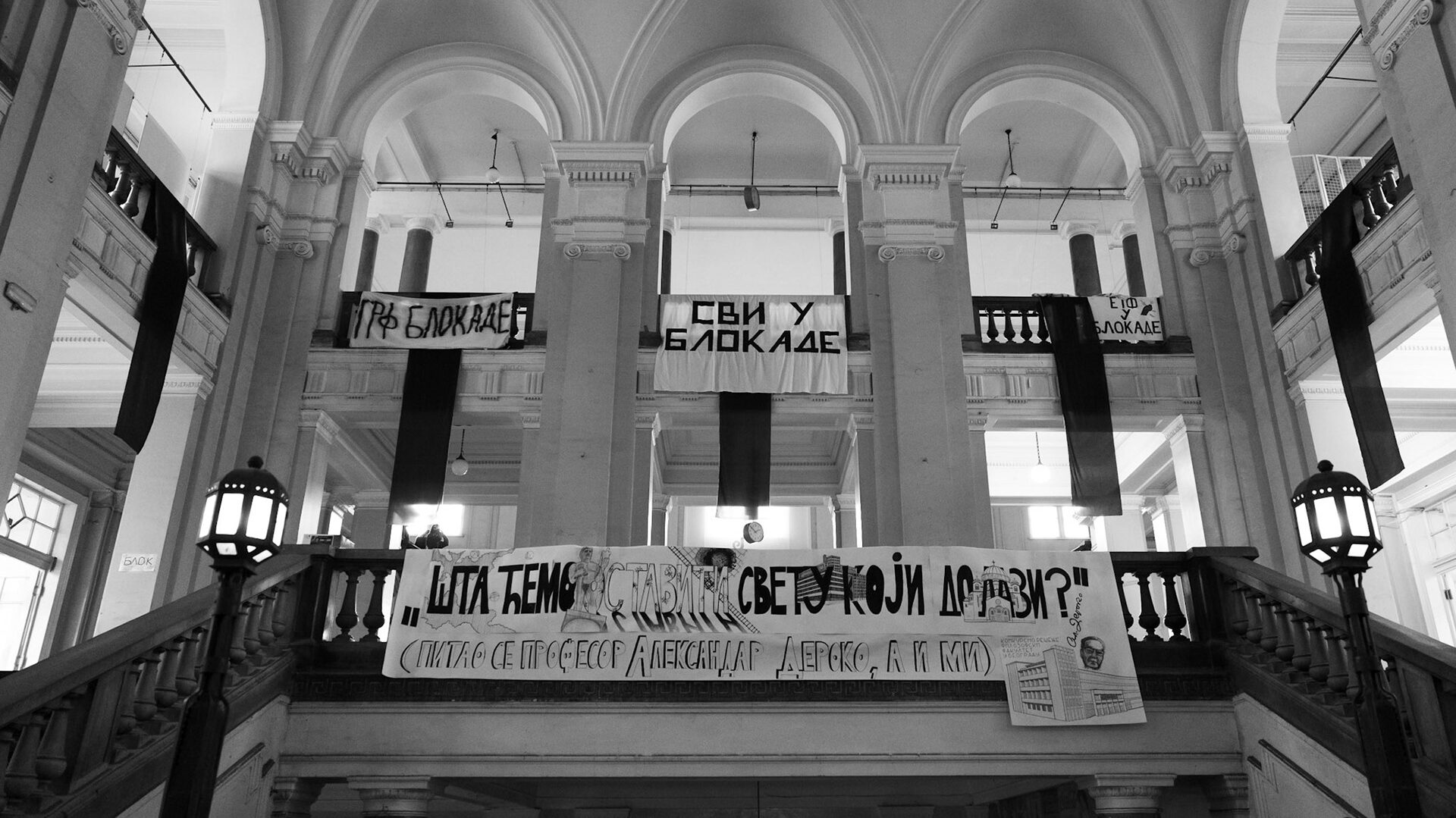
The development of Expo 2027 has been imposed with systematic exclusion of democratic oversight and public participation.
The development of the EXPO site points to strong centralisation of power and the deterioration of legal frameworks, positioning the project as one that works against democratisation.
Unlawful Adaptation of the Spatial Plan for Special Purpose Area
When the Spatial Plan for Special Purpose Area (PPPPN) was initially adopted, it directly contravened the then-current Law on Planning and Construction, specifically Article 33, paragraph 1, which required spatial planning documents to be aligned hierarchically, meaning plans for lower-scale areas must conform to plans for higher-scale areas. The PPPPN fell under three existing plans (the Regional Spatial Plan of Belgrade 2011, the Spatial Plan of Surčin Municipality 2012, and the General Urban Plan of Belgrade 2016), all of which designated the site as agricultural land. By reclassifying this land use without alignment, the PPPPN’s adoption was unlawful.
The current Law has since reformulated Article 33 to establish that PPPPNs sit hierarchically above other planning documents. This is a convenient revision that immunises future special-purpose plans from similar legal challenges. This hierarchical structure immunises executive spatial decisions from local democratic contestation or judicial challenge. It’s a procedural architecture for authoritarian spatial control: in contrast to other higher level plans like the National Spatial Plan that has to be adopted by the National Assembly, the Government can designate any territory “special purpose,” impose its own planning rules via cabinet decree, and legally override local opposition.
Manipulations Regarding Democratic Oversight
Serbia’s government passed special EXPO 2027 legislation in secret, with no public debate and no anti-corruption review, allowing up to €1 billion in contracts to be handed out without competitive bidding to politically connected firms. Over 100,000 citizens have signed a petition demanding cancellation, but authorities continue blocking access to planning documents and ignoring public opposition.
- The special legislation (“lex specialis“) establishing the spatial and legal framework for the project was adopted without public consultation or parliamentary debate, bypassing mandatory consultation with the Anti-Corruption Agency.
- The detailed spatial plan submitted to the Bureau International des Expositions remains inaccessible to the public despite involving massive public expenditure and fundamental spatial transformation. This lack of transparency extends to procurement processes as the special law exempts all EXPO-related contracts from public tender requirements, permitting contracts of up to €1 billion to be awarded without competitive bidding.
- Major construction firms with political connections have received substantial spatial development contracts.
- By March 2025, over 120,000 citizens had signed a petition demanding the cancellation of the EXPO, yet their concerns remain unaddressed in the planning process.
Procedural Manipulations Regarding Public Participation
Spatial projects are required by the Law on Planning and Construction to have an early public insight and a second public review in the later phase of the project planning. This also includes projects developed through a lex specialis; however, in the case of the EXPO 2027, this legal requirement was disregarded.
- The procedural manipulation of the spatial planning process systematically excluded public participation. While the initial Phase I underwent early public review in April 2019, covering 114 hectares, subsequent phases expanding the plan to 813 hectares bypassed this legally mandated step entirely.
- The special EXPO law reduced the public review period from the legally prescribed 30 days to just 15 days, while the mandatory public presentation scheduled for 14 February 2025 was interrupted shortly after beginning and effectively not held; the planning documentation made available during public review was incomplete.
- Systematic obstruction of access to planning information for a project designated as being of “national significance” fundamentally violates principles of public participation and transparency.
Against Sustainable Planning
The project violates fundamental principles of spatial sustainability with its vast land use and environmental destruction. This contradicts the goal of sustainable urbanism set in the Sustainable Urban Development Strategy of the Republic of Serbia until 2030, as well as the Draft of the National Spatial Plan of Serbia, which both align with the UN 2030 Agenda for Sustainable Development.
Vast Land Coverage
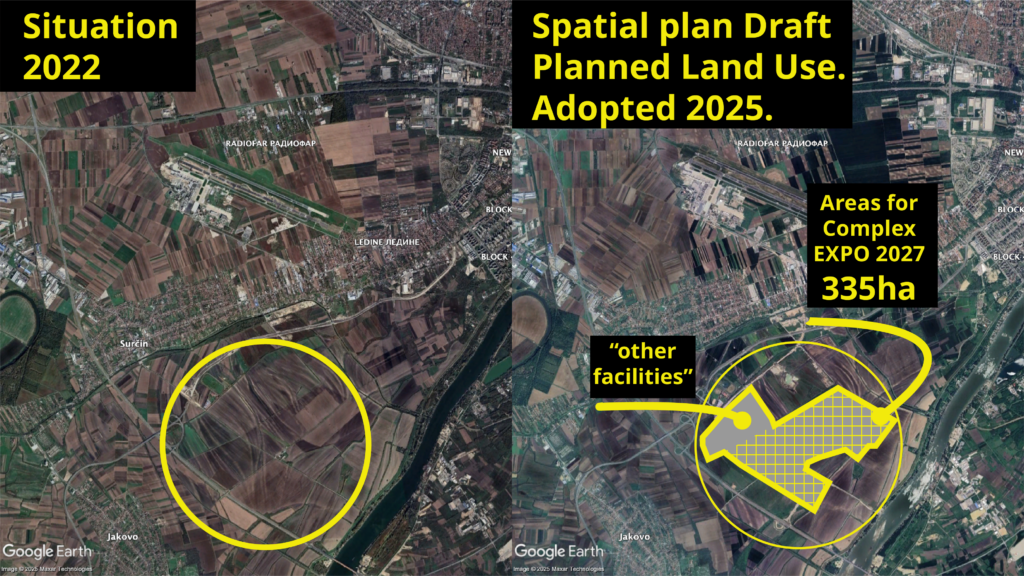
The EXPO complex will consume 335 hectares, which is more than triple the international size limit, including a national stadium built in an expert-rejected location that is expected to sit empty most of the year.
- According to Bureau International des Expositions regulations, the specialised exhibition can occupy a maximum of 25 hectares; yet the spatial plan designates approximately 83 hectares for the EXPO exhibition complex.
- Foreign stadium consultants who designed three World Cup stadiums warned that Surčin’s location, far from the city, could result in the stadium being empty 336 days per year, lacking guaranteed economic sustainability even with a shopping centre nearby. Despite expert recommendations for Ada Huja due to its riverfront location and urban integration potential, authorities selected Surčin primarily because of its connection with the Expo project, raising questions about financial transparency and decision-making processes.
- Moreover, the plan establishes “further use of realised content” as a basic objective, which it purports to “enable” through the construction of an additional 252 hectares of commercial content, directly contradicting the foundations of sustainable development by its sheer scale.
Environmental Destruction
The spatial plan also envisions converting 600 hectares of highly fertile agricultural land into building parcels for single-use construction, permanently eliminating productive agricultural space.
- Construction of objects on numerous deep piles penetrates the protective aquifer layer, creating multiple direct channels for contaminated surface water to enter the underground water source without filtration.
- The planned international marina in the hydrographic zone of the infiltration wells threatens water contamination from construction and vessels, changes in hydrodynamics and sedimentation, alterations in underground flows, mechanical damage to the well system, reduced filtration capacity, and long-term reduction of well capacity.
- The urbanisation of Surčin Field through extensive concrete coverage reduces the soil’s infiltration capacity, increasing flood risk in an area already vulnerable to inundation.
- In the national budget for 2025, nothing has been determined for the treatment of wastewater and sewerage in the Project area.
Despite being located in the narrow sanitary protection zone of the water source, the plan nevertheless designates two marinas, a pontoon, and river traffic.
- Disregard of Regulations on Environmental Protection
At the same time, the Environmental Impact Assessment, which should serve as the basis for building permits, was not conducted before construction began on the stadium; instead, its preparation proceeded in parallel with construction works, which, by Serbian law, constitutes illegal construction.
- The Serbian Academy of Sciences and Arts issued a formal warning in February 2025 stating that the project poses risks of “irreversible environmental damage” and threatens Belgrade’s water supply infrastructure.
For more information on environmental aspects, see here.