14. 3. 2026.
Link to the original article: https://radar.nova.rs/ekonomija/nacionalni-stadion-ada-huja-surcin-fenvik/
Foreign consultants, who designed three stadiums for the World Cup in Qatar, have warned that the stadium in Surcin could be empty 336 days a year and that it is not certain that it will be visited even if a shopping center is built next to it. There was no one to hear them, or the government didn’t really care about it
The SNS government will spend 1.2 billion euros from the citizens’ treasury on the construction of the National Stadium in Surčin, but the problem is not only the extremely high price. It is unclear why Surčin was chosen as the location, bearing in mind that the main designer, the renowned Spanish house Fenwick Iribaren Architects, which Aleksandar Vučić often referred to, preferred Ada Huja. As stated in the report of representatives of Fenwick who visited both locations, Ada Huja is an excellent option for the construction of a stadium, due to its proximity to the river that would attract people even when there are no matches, due to its proximity to the city center, and the development of the settlement itself.
On the other hand, Fenwick assesses that there are many negative aspects and concerns when it comes to the location in Surcin – it is far from the city, the stadium could be empty 336 days a year, without additional facilities, and even if a shopping center is built in the immediate vicinity, it is not certain that it will be visited. The only positive thing is that the land is cheaper and suitable for construction.
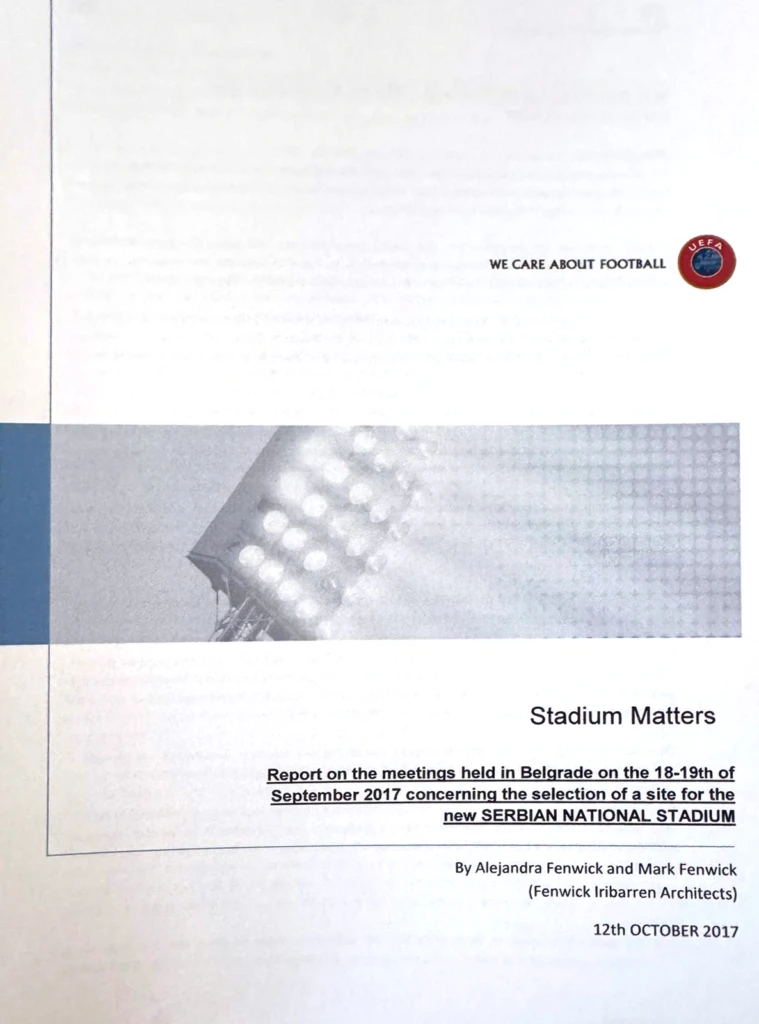
Ada Huja as a location for the construction of the National Stadium had almost no disadvantages. This can be concluded from the report of Spanish designers Alejandra and Mark Fenwick, representatives of Fenwick Iribarren Architects, dated October 12, 2017, otherwise known for designing three of the eight stadiums in Qatar for the 2022 World Cup. The report was written after their visit to Belgrade, which took place on September 18 and 19, 2017.
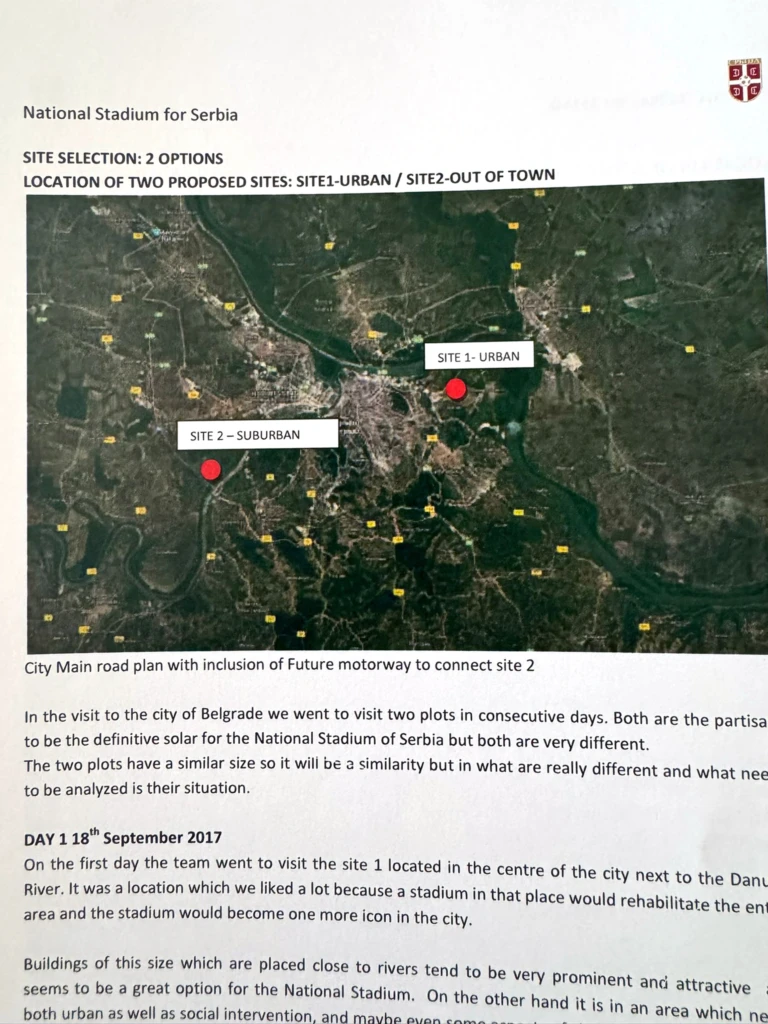
On those very days, they visited Ada Huja, which was proposed by the Belgrade City Assembly, and Surčin, and then they compiled a report on the selection of the location for the National Stadium. They conclude in that document that the similarity is in the size, that is, the area of the proposed plots, but that they differ significantly both in terms of location and context.
Stadiums near rivers and city centers are much more attractive
“On the first day, the team visited site 1, which is located in the city center next to the Danube River. It is a location that we really liked, because a stadium in that place could contribute to the revitalization of the entire area, and the stadium itself would become another city symbol. Facilities of this size that are located near rivers are often very prominent and attractive, so this seems to be an excellent option for the National Stadium. On the other hand, it is located in an area that needs urban and social intervention, i.e. further development and landscaping,” the report says. Fenwick.
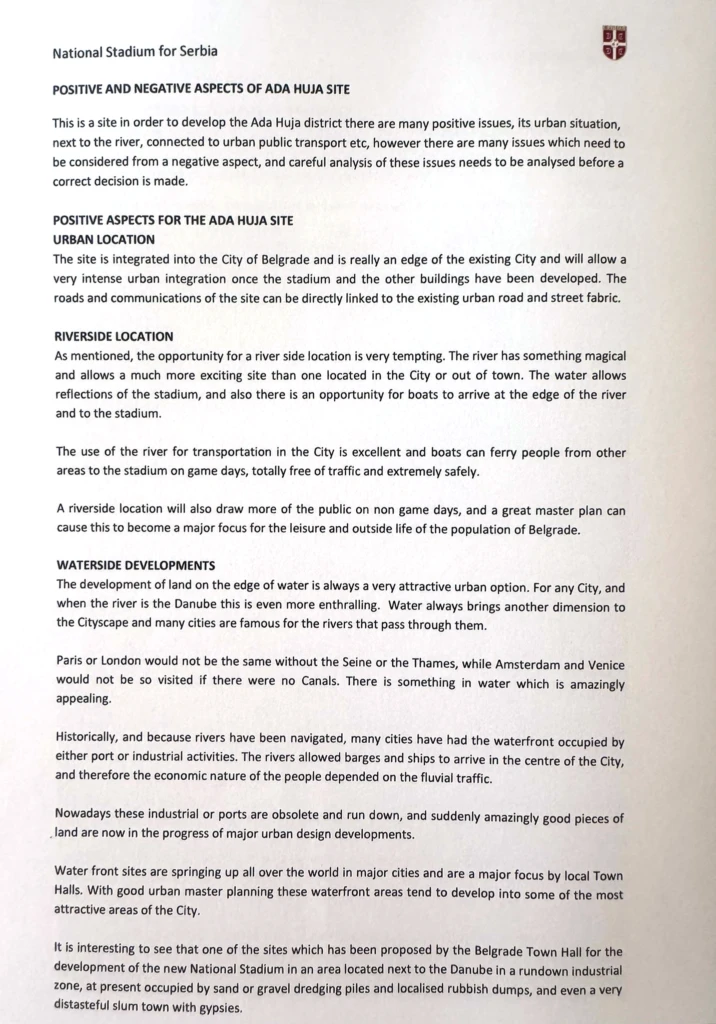
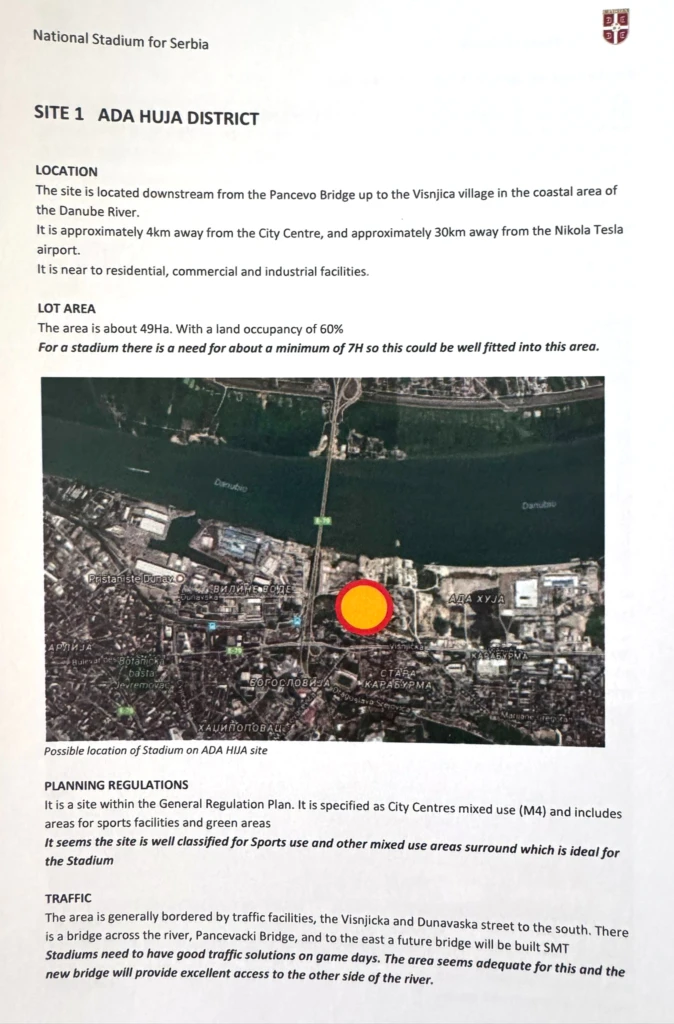
In that document, it is further stated that the location for the stadium on Ada Huja is located downstream from the Pancevac bridge, to the village of Višnjica, in the coastal area of the Danube. It is about four kilometers from the city center, about 30 kilometers from the “Nikola Tesla” Airport, and there are residential, commercial and industrial zones nearby. Fenwick’s report further states that the area of the plot on which the stadium would be built is approximately 49 hectares, and that the permitted development of the land is 60 percent.
The construction of a stadium next to the Danube, on Ada Huja, could contribute to the revitalization of the entire area. Facilities of this size, located close to rivers, are very attractive and this appears to be an excellent option for the National Stadium, according to the Fenwick report.
“The stadium requires a minimum of about seven hectares, so this project can fit well into this space. The site appears to be well classified for sports facilities and other mixed uses in the surrounding area, which is suitable for a stadium,” the document states.
The experts hired by the state further conclude that the area on Ada Huja is surrounded by traffic roads, that Višnjička and Dunavska Streets are located south of the site, there is also the Pančevački bridge, and the construction of a new bridge (Bridge over Ada Huja) is planned to the east. They remind that stadiums must have good traffic solutions for match days, and it seems, they state, that this area is adequate for such a function, especially with the construction of a new bridge.
“This is a location that can contribute to the development of the Ada Huja district. There are many positive factors: urban position, proximity to the river, connection with public city transport… The location is integrated into the city of Belgrade and represents a kind of edge of the existing city. The development of the stadium and accompanying facilities would enable a strong urban integration of this area. Road infrastructure and communications can be directly connected to the existing city network of streets,” the report says.
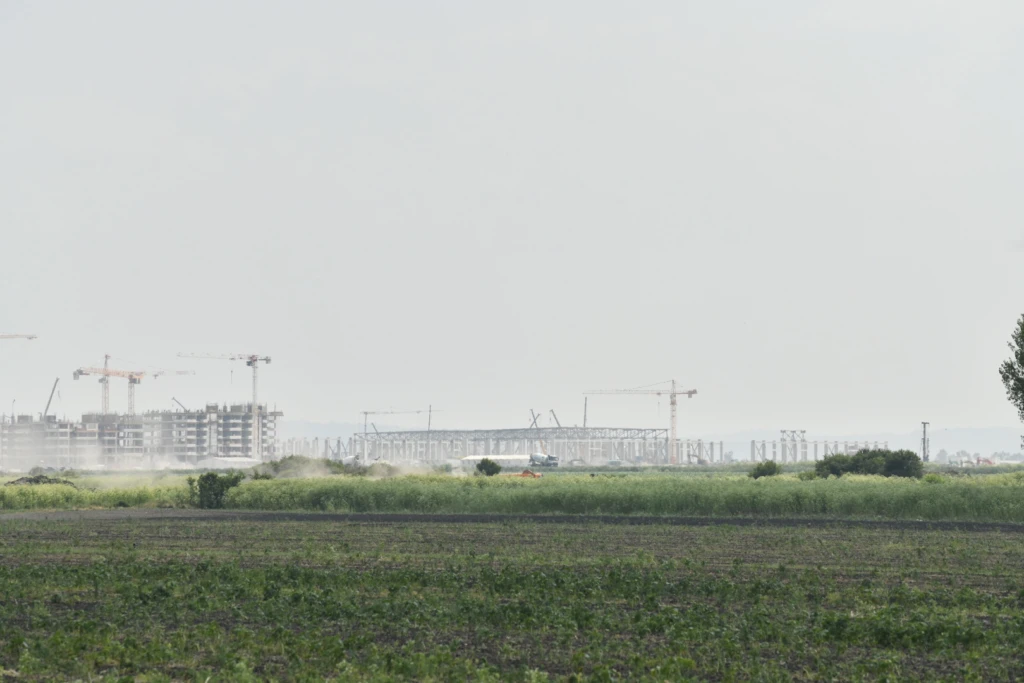
It is further stated that the area along the river is very attractive, that the river has a special character and “makes the location more exciting than when the property is located in the center or outside the city”.
“The water enables the reflection of the stadium, and there is also the possibility of arriving by boat or ship directly to the stadium. The location along the river would attract people even outside of match days, and a good urban plan could make this place an important center for recreation and social life of the citizens of Belgrade… For every city, and especially when it comes to the Danube, water gives a new dimension to the cityscape. Cities like Paris or London would not be the same without the Seine or the Thames, while Amsterdam and Venice would not be so visited without their canals. In the water there is something extremely attractive,” experts conclude.
The document further states that the Ada Huja site is currently a neglected industrial zone, with sand and gravel embankments, local waste dumps, and even a makeshift settlement. And it can be concluded that this is the only negative that Alejandra and Mark Fenwick concluded about Ada Huja as a location for the National Stadium .
There are many minuses and only one plus for the location in Surčin
Although they had almost no objections, Ada Huja was rejected as a proposal for the location. Preference was given to Surcin, to whom a number of objections were raised. Fenwick’s report says that the main problem is that the location of the stadium is far from the city.
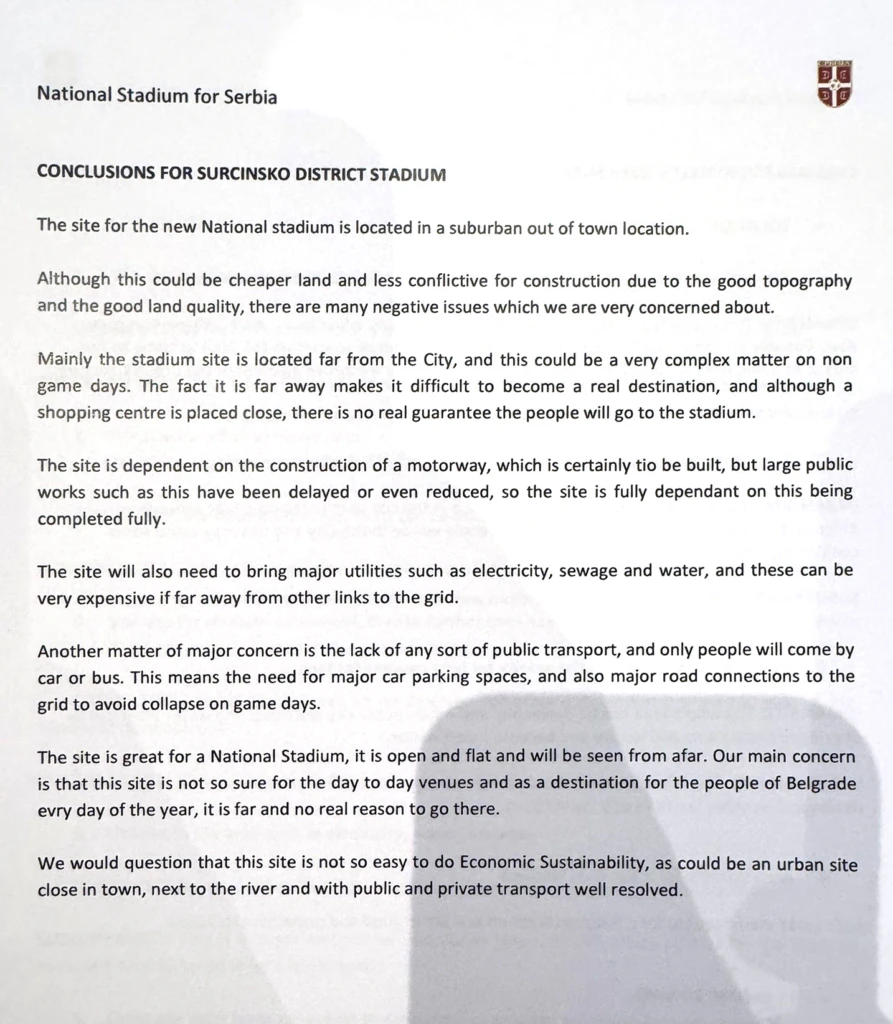
“Although the construction (in Surcin) could mean cheaper land and less construction conflicts due to good topography and quality land, there are many negative aspects about which we are very concerned. The main problem is that the location of the stadium is far from the city, which can be a very complex problem. The fact is that it makes it far more difficult to become a real destination and, although there is a shopping center nearby, there is no real guarantee that people will come to the stadium. The location depends on the construction of the highway, which is certainly planned to be built, but large public works like this can often be delayed or even reduced, so the location is entirely dependent on whether this project will be fully completed,” the document states.
When choosing the location, Surčin was chosen because of its connection, not only physical, but primarily financial and corrupt, with Expo, which increases doubts about the way of planning and the justification of investing state money
Daniel Dasic
It goes on to add that construction in Surcin would require bringing in electricity, sewage and water, “which can be very expensive”, and another big cause for concern, Fenwick points out, is the complete lack of public transport. It’s great that the site is open and flat and can be seen from afar, but…
“The main concern is that this location is not as safe for everyday events as a destination for people from Belgrade every day of the year – it is far away and there is no real reason to go there. We question whether economic sustainability in this location is easily achievable, as it would be in an urban location close to the city, next to the river and with well-managed public and private transportation,” says Fenwick.
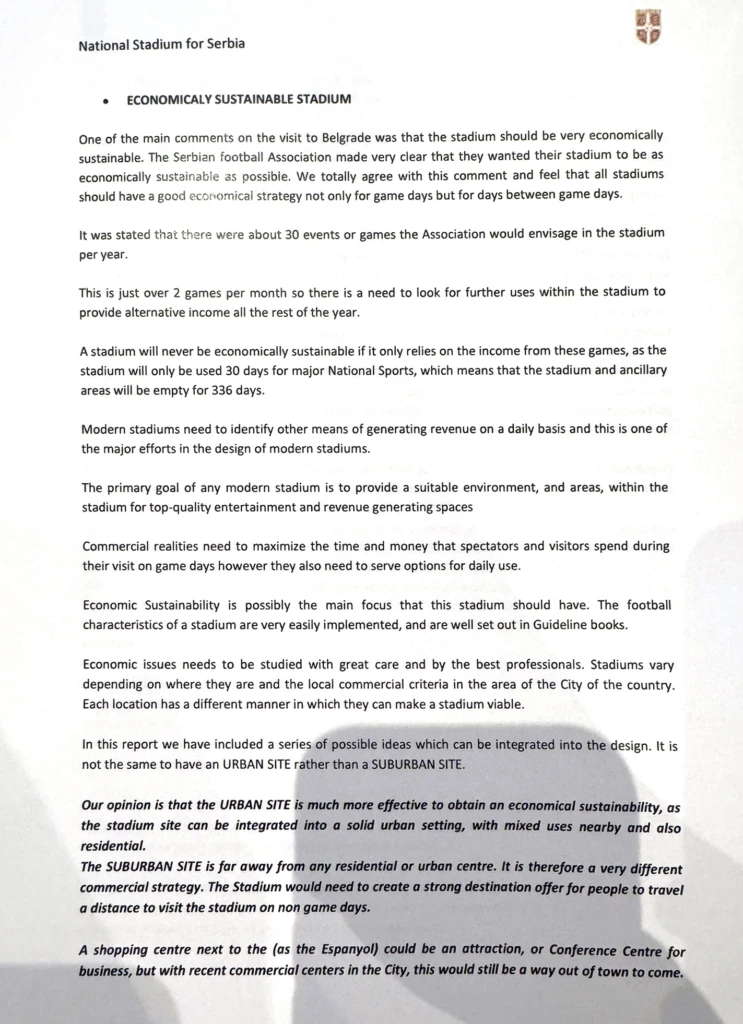
In the report of experts from Spain, it is stated that the Football Association of Serbia has made it clear that it wants a stadium that will be as economically sustainable as possible and that it anticipates that there will be around 30 events or matches per year, which will be slightly more than two matches per month, so there is a need to find additional uses within the future facility, in order to provide alternative income during the rest of the year.
“The stadium will never be economically viable if it relies only on revenue from those matches, as it will only be used 30 days a year for major national sporting events, meaning that the stadium and supporting areas will be empty 336 days a year. Modern stadiums need to identify other ways to generate revenue on a daily basis,” stated Alejandra and Mark Fenwick and pointed out that an urban location on Ada Huja is much more effective for achieving economic sustainability.
The government chose Surcin only because of the Expo
Despite the concerns of Spanish experts and the clear favoring of the location on Ada Huja, the government decided on a suburban area, in which, only when it comes to the National Stadium and infrastructure, they will invest around 1.2 billion euros. Danijel Dašić, a civil engineer and a member of the Survey Commission for investigating the fall of the canopy, tells Radar that Surčin was chosen as the location for the National Stadium primarily because of the Expo international exhibition.
A stadium will never be economically viable if it only relies on revenue from 30 games or major national sporting events per year. Modern stadiums need to identify other ways to generate revenue, according to Alejandra and Mark Fenwick
“When choosing the location for the construction of the National Stadium, the Surčin location was chosen because of the space for expansion and connectivity, not only physical, but primarily financial and corrupt with Expo. Ada Huja, although a far more attractive location, closer to the center, is more demanding in terms of arranging infrastructure and access to roads. Of course, if any capital investment in Serbia in the last ten years had been selected and built in accordance with EU standards that prescribe the participation of citizens and experts, this decision would have been clear, explained and grounded in the publicly announced studies of feasibility and economic justification, with a transparent tender procedure. Thus, many questions and doubts about the way of planning and the justification of investing state money remain open,” concludes Dašić.
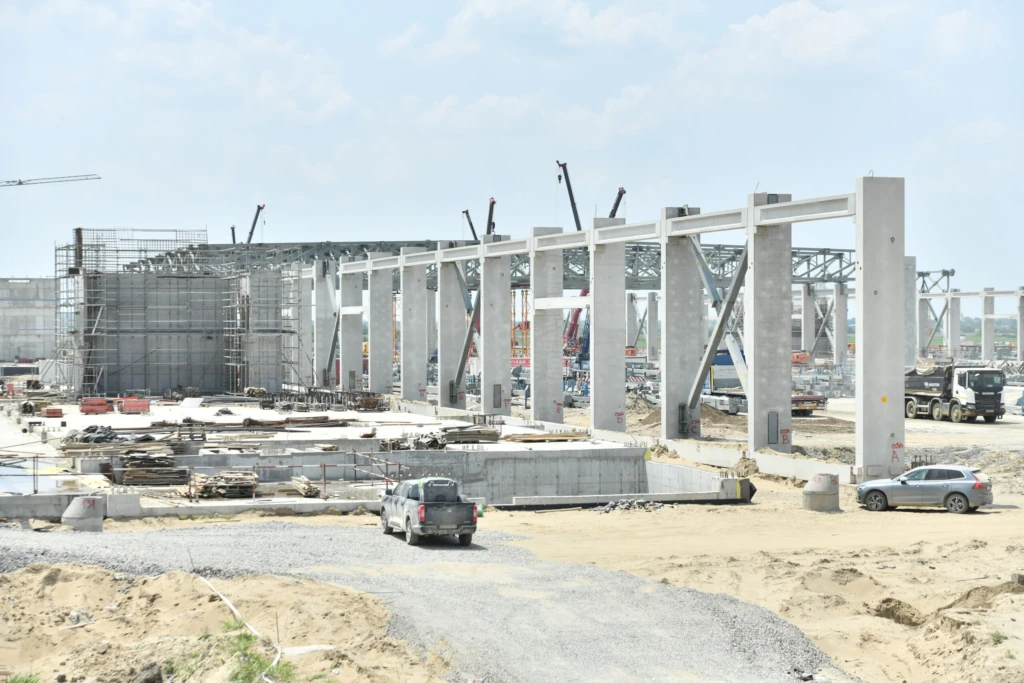
And in this project, perhaps as expected, a huge amount of money will be invested, about 1.2 billion euros, together with the infrastructure, that is, the railway from Zemun Polje to the National Stadium, which will cost about 430 million euros. However, the Ministry of Finance, in the denial submitted to Radar in response to the text in the previous issue, claims that it is the track for the Expo , not the National Stadium, and that the feasibility study carried out by Fenwick and Mašinoprojekt KOPRING showed that the construction of the stadium itself will cost 392 million euros, with a possible deviation of up to 10 percent. Whatever was written in the Study, the data obtained by Radar show that 388 million euros have been allocated for that project by the beginning of this year, and that a total of 768 million will be spent by the end of 2028.
And all this is reminiscent of the case of the Belgrade Metro. And it’s not just about a project that is worth billions of euros and whose price just jumps, so much so that we can’t “catch” it. The public was shocked that the subway would start from a place where no one lives. It could have been the same for the National Stadium, but fortunately SNS companies thought of building apartments there, so I guess someone will buy them. All that remains is to buy tickets for matches at the entrance to Surčin before the next elections , which could be as early as December. Like those for the subway.
Fenwick Report with recommendations and evaluations of possible sites for stadium construction