The Cultural Sector: Blackmail, Boycotts, and the Individual Cost of Dissent
The cultural sector has become the main arena for EXPO-related socio-cultural tensions, shifting from financial pressure to direct, targeted political repression. In 2025, the Ministry of Culture introduced two funding streams: a standard annual call with modest grants and a separate competition for EXPO-related programs with significantly larger awards (up to 8 million RSD). Cultural journalists assert that this structure constitutes financial blackmail, as artists must either apply for EXPO-branded funds, which implicitly support the government project, or they risk organisational collapse. The crisis extends far beyond funding; it is a systematic campaign of individual retaliation against those who refuse to comply.
- Budget money from culture to EXPO: Regime blackmails the whole culture scene, Danas, June 2026
- Whoever wants to shoot movies, should talk to EXPO, Vreme, June 2026
The Chronicle of Repression: Citizens as Archivists
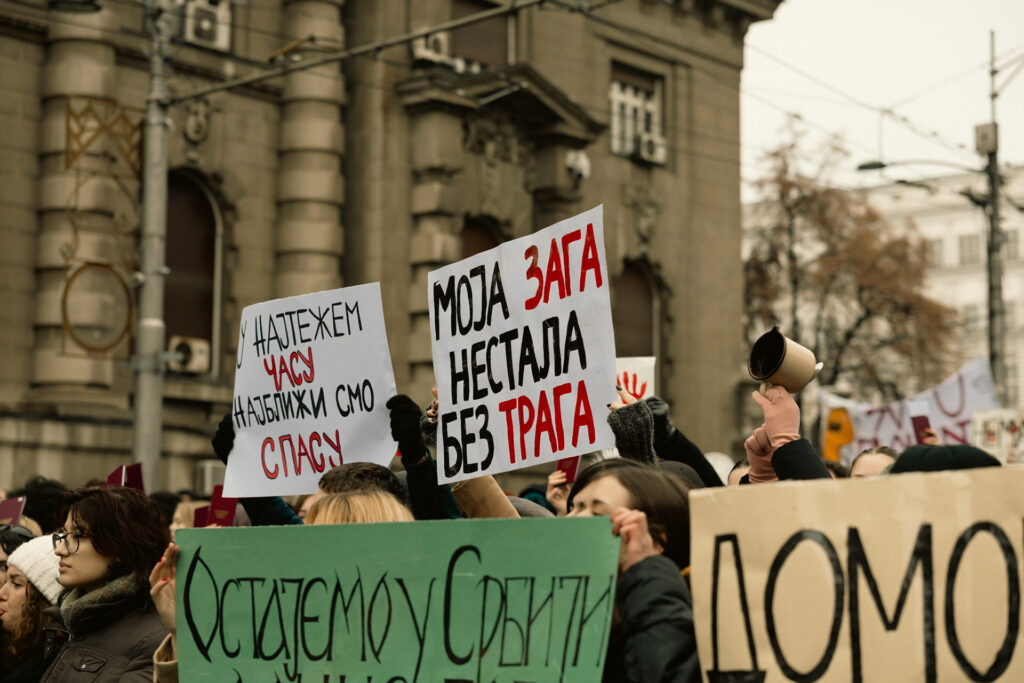
A key indicator of this systematic abuse is the need for citizens to document their own persecution. In response to official silence and a judiciary that does not record or prosecute attacks, the Community of Arts and Culture (Zajednica umetnosti i kulture – ZUK) created the “Chronicle of Repression in Culture” (Hronika represije u kulturi). This initiative aims to prevent the isolation of victims and to serve as a collective record of all instances where state institutions have failed. Within one month (November–December 2025), ZUK collected 37 detailed reports of repression across nine cities, including Belgrade, Novi Sad, and Zaječar. The chronicle’s existence highlights a lack of trust in institutions to protect rights or acknowledge violence. As the UN Working Group noted, when the state fails to investigate, “impunity becomes the norm,” leaving victims as the sole archivists of their own suffering. Independent outlets such as Mašina have described this period as a year of “dislocated jaws, broken noses, and smashed heads” that police reports routinely omit.
- UN Working Group report, May 2026, paragraph 17
Direct Retaliation: Firings, Mobbing, and Blocklists
The ZUK Chronicle documents repression that is both personal and damaging, targeting individual livelihoods and mental health through measures that extend far beyond official institutional channels.
- Terminations and Mobbing: The database details several politically motivated dismissals. For example, Momir Pejatović, a technician with 22 years at the National Theatre in Leskovac, was dismissed in February 2025 for supporting student protests. By November, his case still remained unheard in court. In Novi Sad, twelve ballet dancers from the Serbian National Theatre were forced into early retirement for supporting students and replaced by foreign dancers, while local graduates were denied positions.
- Psychological Impact: Victims report significant psychological distress. One respondent described the experience as “stress and hell… 8 months without a single dinar of income,” resulting in the inability to pay mortgages and severe anxiety.
- Blocklists: In the private sector, “blocklists” function discreetly but effectively. Musicians and actors known for dissent are banned from public broadcasters and private clubs. According to the mapping report, producers face the “impossibility of placing realised work” and “bans on working in other productions,” effectively ending careers without formal explanation.
Institutional Weaponisation: The Use of Rules as Instruments of Control
The state has weaponised bureaucracy to suppress dissent. Recent internal regulations and disciplinary rules at major institutions, such as the National Theatre in Belgrade and museums, now require employees to obtain written permission for any media contact or public statement. These measures are explicitly designed to silence critics and enforce loyalty. Furthermore, arbitrary fire safety regulations are frequently cited to cancel performances by independent artists who supported protests, while pro-government events continue uninterrupted in the very same venues. In Zaječar and other locations, directors have threatened to close entire institutions and dismiss all staff if employees continue supporting protests—effectively weaponising the livelihoods of the majority to pressure a few targeted activists.
The UN Working Group’s report confirms this by documenting a “shrinking civic space” where civil society organisations face intimidation and surveillance. The report specifically notes that in January 2025, 29 civil society organisations suspended all cooperation with government bodies due to these pressures. The Working Group also highlighted the use of strategic lawsuits against public participation (SLAPPs) targeting journalists and activists, with 14 cases recorded in 2025.
- UN Working Group report, May 2026, paragraphs 25, 28
The final appeals of the Serbian cultural sector
Current conditions in the cultural sector have prompted the Community of Arts and Culture to launch a boycott campaign, urging international colleagues to avoid EXPO 2027. This initiative directly responds to deep concerns regarding institutional non-transparency and corruption. The group argues that international participation ultimately contributes to the regime’s image laundering, and their appeal explicitly asks foreign institutions not to mistake state-sponsored messaging for the authentic voice of Serbian artists.
- Serbia’s Artists Call for International Boycott of Expo 2027 as Cultural Repression Deepens, May 2026
For individual citizens, EXPO has been transformed into a tool for enforcing state discipline. Dissent is not only discouraged but actively criminalised, exposing critics to severe risks including criminal records, imprisonment, social exclusion, physical harm, and professional repercussions. The “Chronicle” serves as evidence of this reality, recording acts of resistance within a system designed to suppress them.
Protest Movements and the Remaking of Public Space
EXPO 2027 has become a focal point for broader social unrest. Architecture students, urban activists, and local citizens have organised demonstrations linking the mega-project to chronic issues of national debt, systemic corruption, and environmental risk. Protesters argue the project will impose crippling financial burdens on future generations and actively threaten Belgrade’s primary water sources.”
- EXPO blocked after the warning that it endangers Sava embankment, Masina, February 2025
- International meeting on EXPO happened next to student and citizen protests in Belgrade, Slobodna Evropa, June 2025
These protests rapidly aligned with wider student mobilisations following the catastrophic canopy collapse in Novi Sad. The UN Working Group confirmed the severity of the state’s subsequent response, noting that peaceful demonstrators were subjected to a disproportionate use of force, including the alleged deployment of a long-range acoustic device, assaults by unidentified individuals, and arbitrary arrests. These reprisals carried significant personal consequences: students were expelled from universities for disrupting public order; professors lost tenure for publicly supporting their students; activists faced terrorism-related criminal charges simply for posting stickers; and journalists received death threats for reporting on the site.
- UN Working Group report, May 2026, paragraph 23
These are not abstract violations of civic space but targeted acts of repression against individuals. The UN report further notes that dozens of activists faced criminal proceedings after the protests, with many subjected to hostile state-media campaigns labeling them as “enemies of the State.”
- UN Working Group report, May 2026, paragraph 27
International Implications
The socio-cultural controversy surrounding EXPO is no longer confined within Serbia’s borders, as European institutions have noted broader rule-of-law concerns. This section documents how European Parliament resolutions urge governments to “take into account serious concerns and evidence of widespread corruption linked to the ruling authorities.”
The UN Working Group’s report reinforces these international concerns, stating that the “lack of transparency in public procurement processes, with resultant questions about corruption, was frequently mentioned as a cause of serious concern.” The report specifically highlights that EXPO 2027 procurement was entirely exempt from standard public tender requirements. In response, civil society groups have submitted formal notices to the Bureau International des Expositions (BIE) outlining alleged systematic legal violations, backed by a public petition that gathered over 120,000 signatures.
- UN Working Group report, May 2026, paragraph 16
Effects on construction workers
Labour conditions at EXPO construction sites reveal deep-seated, underlying social hierarchies. Investigations show that dozens of foreign workers from Turkey, China, and other nations have worked without legal contracts or permits, with some forced to flee when inspectors arrive. Reports indicate that these workers have been misled about their legal status, threatened with non-payment, and made entirely dependent on their employers for accommodation—all of which serve as clear indicators of severe labour exploitation.
- Illegal Works on the EXPO: Working off the Books and Fleeing from Construction Site, CINS, March 2026
- 56 Illegal Workers on EXPO, Forbes, 2026
The Working Group documented cases where foreign workers incurred recruitment debts of up to US$10,000, had their passports confiscated, and faced delayed wages and intimidation. The report explicitly links these abuses to “weak State oversight” and a heavy reliance on complex, opaque subcontracting chains.
- UN Working Group report, May 2026, paragraphs 78, 79
This exploitation stands in stark contrast to a project heavily promoted as a European-style festival of openness and play. By depending on the precarious labour of migrant workers, the state reinforces a hierarchy that renders these individuals invisible and expendable. Read more from our construction perspective.
Ecological Controversies as a Backdrop
Although this social perspective does not focus on environmental issues, it provides important context for socio-cultural conflict. Urbanists and environmental activists warn that EXPO and its related projects directly threaten Belgrade’s Sava riverbank and the vital Surčinsko polje water-supply zone. Crucially, lex specialis provisions allow construction to proceed with severely reduced legislative oversight.
- Belgrade’s EXPO 2027 shining light and shadows, CEP, December 2023
- EXPO blocked after the warning that it endangers Sava embankment, Masina, February 2025
The UN Working Group’s report documents significant failures in environmental governance that amplify these risks. It finds that environmental impact assessments (EIAs) in Serbia often “omit mandatory elements” and that large-scale projects are intentionally fragmented to bypass legal requirements. The Working Group also notes that current regulations allow major projects to proceed without comprehensive environmental scrutiny.
Consequently, the UN recommends that the government withdraw or amend the special legal framework for Expo 2027 and restore existing safeguards and public oversight of public procurement, planning, and construction laws. Ultimately, these environmental concerns echo the broader cultural and social critiques, exposing a political willingness to sacrifice long-term ecological well-being for a short-term spectacle.
- UN Working Group report, May 2026, paragraph 35, page 21
A dedicated section on ecological issues is available here.
Contrasting Official Narratives with Lived Realities
Similar to the cultural sector, other areas of society are being directed toward participation in the EXPO.
- Significant budget cuts have affected projects aimed at improving the lives of persons with disabilities. The Ministry for Labour, Employment and Social Rights now requires that any submitted project be linked to the EXPO.
- EXPO 2027 has been added to Serbia’s school calendar. Although the ministry states that not all students are required to participate, schools must still plan for the event. However, there is currently no clear guidance regarding logistical or financial support, nor is there a defined curriculum for student engagement at the exhibition.
- The Ministry of Finance announced that students who volunteer for the EXPO will receive additional ESPB points to support their academic progress. While this could be appropriate if aligned with faculty curricula, the university stated that it was not consulted. It remains unclear who will determine the nature of student volunteer activities and how these will be academically recognised. Additionally, applications are being processed through a specialised EXPO portal rather than through universities. To date, this process bypasses public universities instead of enabling them to offer meaningful, practical experiences for students.
Official narratives present EXPO 2027 as an opportunity to showcase Serbia’s creativity and attract investment. However, recent actions suggest a lack of attention to concerns about forced labour. US Customs and Border Protection (CBP) blocked imports from at least two companies operating in Serbia for forced labour violations in December 2025 (Linglong International Europe D.O.O., Zrenjanin) and in June 2026 (Serbia Zijin Copper D.O.O.). Rather than investigating, the government has remained silent. On the contrary, president Vučić proudly announced new investments by Linglong in May 2026, only five months after they were placed on the CBP no-import list. In this type of business and political environment, many citizens, including persons with disabilities, students, teachers, artists, and migrant workers, experience that EXPO is something being done to them rather than with them. Their budgets are cut and blackmailed with EXPO participation, their labour is solicited on unfavourable terms, their institutions are pressured, and their protests are met with police cordons.
The UN Working Group’s conclusion mirrors this disconnect. It stresses that “development projects and investment seem increasingly pursued on the flawed assumption that economic development and human rights protections are incompatible”. The report warns that while promoting foreign investment may serve a legitimate aim, “economic objectives are not adequately balanced with sustainable resource use and the protection of human rights and the environment”. The gap between promotional slogans and everyday reality is precisely what fuels the growing domestic and international campaigns against the project.
- UN Working Group report, May 2026, paragraph 111
Evidence from civil society, investigative journalists, and the United Nations shows that Belgrade EXPO 2027 reflects broader shifts in Serbian society. Exceptional laws, reallocation of social funds, coercive volunteering, and cultural pressure are creating a system where access to resources, visibility, and security increasingly depend on association with the project.
The UN Working Group’s recommendations address these institutional challenges, including the mandatory human rights due diligence, protection of civil society, and restoration of legal safeguards for EXPO 2027. At present, the slogan “Play for Humanity” stands in contrast to reports of disabled citizens awaiting services, students assigned unpaid work, artists choosing between boycott and bankruptcy, and migrant workers avoiding inspectors. Reducing the social costs of EXPO 2027 will require domestic and international stakeholders to ensure that cultural diplomacy and democracy do not come at the expense of those whose labour and rights support the event.
UN Working Group report, May 2026, paragraph 10