Robbery without borders. How much did the “Serbian” railway built by the Chinese and Russians actually cost?
Radar, September 2025
Link to original article: https://radar.nova.rs/ekonomija/cena-srpske-pruge-kinezi-rusi/
So far, each kilometer of railway from Novi Sad to Kelebija has been paid 11.6 million, from Belgrade to Stara Pazova 13.8 million, and from Stara Pazova to Novi Sad as much as 14.9 million dollars. Even that was not enough, because the government planned to continue using that project for further money extraction
Tragically, but true, Annex 5, which has since been withdrawn, although it was adopted by the Railway Infrastructure of Serbia on June 12, and confirmed by the Government on July 24, as well as the sixth which was allegedly prepared, is planned to further extract money from the railway reconstruction project from Novi Sad to Kelebija in the amount of almost 160 million dollars . Although, according to the available documentation, which includes the Commercial Agreement and four annexes, 1.25 billion dollars have already been spent on that section.

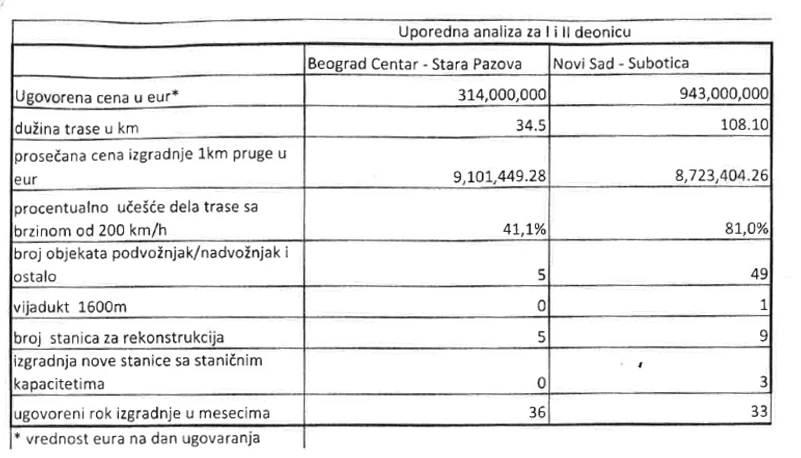
These data also shed new light on the email correspondence obtained by the Commission of Inquiry to investigate responsibility for the collapse of the canopy. In it, the then Deputy Prime Minister and relevant minister Zorana Mihajlović informed the Chief of Cabinet of the President of Serbia Ivica Kojić on her own initiative, it is not known on what grounds, that in the negotiations led by the Railway Infrastructure, with the then director Miroljub Jevtić at the head, it was achieved that the price of the construction of the railway section from Novi Sad to the state border was lowered by 147 million euros . In order to approve the proposed reduction, Kojić requested a comparative analysis of the construction costs of the section from Belgrade to Stara Pazova and from Novi Sad to Kelebija.
And a comparative analysis of costs indicates numerous irregularities
This analysis, shown in table 1, was submitted electronically to Kojić on April 17, 2018 by the former state secretary in the Ministry of Construction, Transport and Infrastructure, Imre Kern, and it already at first glance confirms the suspicions of numerous irregularities in the reconstruction and modernization project of the railway from Belgrade to Kelebija. According to that analysis, namely, each kilometer of the first section, from Beograd Centar station to Stara Pazova, cost 9.1 million euros, and the railway from Novi Sad to Kelebija 8.7 million euros, although the second section has twice as many kilometers of railway for speeds of up to 200 kilometers, and the planned works included the reconstruction of a large number of existing or the construction of new station buildings, one viaduct and a large number of underpasses and overpasses. Even the shorter construction period, which in December 2022, President Aleksandar Vučić asked to be further shortened.
Don’t lie down – The commercial contract for the section from Prokop to Stara Pazova was signed on November 5, 2016, based on the Conceptual Project. By the terms of reference of February 20, 2015, for the preparation of the feasibility study and conceptual project, item 4.1. the content of the Conceptual Project is defined, and subsection 5 specifies the Bridge Project – bridges, viaducts, underpasses, overpasses. The terms of reference for the construction permit project from June 22, 2017 defined that the condition of the existing bridges must be determined, possible measures for their rehabilitation should be proposed, the drainage of the railway and buildings should be solved, hydraulic checks of the culverts and bridges should be carried out, and the negative effects of noise from railway traffic on populated areas along the railway should be examined, which is why constructions – noise protection walls are provided.
Some of the planned works were omitted, but the price was not reduced
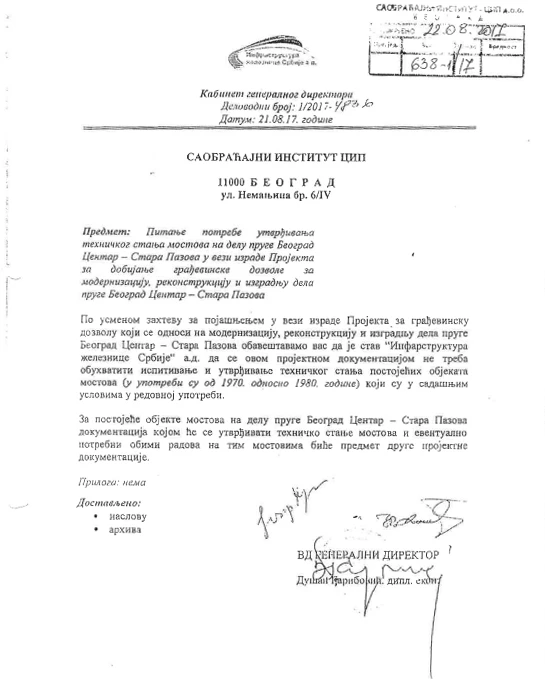
It turned out, however, that CIP, as a designer, did not prepare a project in accordance with the Project for a construction permit, because the works on the examination of bridge structures, the rehabilitation of bridges and the construction of barriers for noise protection on the Hajdin Bridge were omitted at the request of the Railway Infrastructure. Namely, in the response of the Railway Infrastructure dated August 21, 2017 to the oral request of the CIP regarding the clarification related to the preparation of the Project for the building permit related to the section of the BG Centar – Stara Pazova railway, which was reached by the Commission of Inquiry, the Infrastructure takes the position that the project documentation should not include “examination and determination of the technical condition of the existing bridge structures (in use since 1970, i.e. 1980) which are in current conditions in regular use”. Infrastructure further states that the documentation that will “determine the technical condition of the bridges and possibly the required scope of work on those bridges” will be the subject of other project documentation.
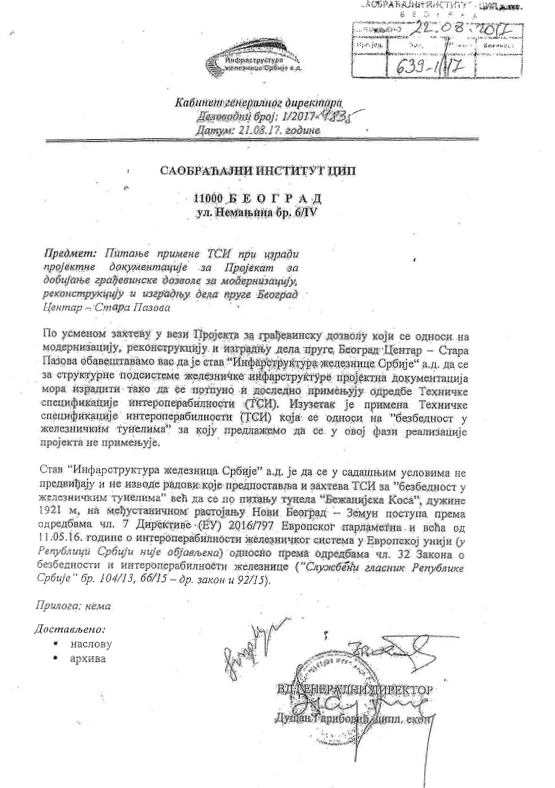
And that, of course, is not all. The survey commission has a document that confirms that on the same day, August 21, 2017, the Railway Infrastructure of Serbia , at the oral request of the CIP, took the position that “for the structural subsystems of the railway infrastructure, the project documentation must be prepared in such a way that the provisions of the Technical Specification for Interoperability are fully and consistently applied”, with the exception that “refers to safety in railway tunnels”. Technical specifications for interoperability (TSI) are standardized technical documents that define the conditions that must be met by different parts of the railway system in order to be mutually compatible and interoperable at the European level. These specifications include all subsystems of the railway system, including infrastructure – tracks, stations, bridges, tunnels…
Instead of 1.1 billion dollars, the construction of the railway from Novi Sad to Kelebija has so far, according to the data from the Commercial Agreement and four annexes, already cost 1.25 billion, and the government planned to spend another 160 million dollars on that section
Infrastructure, therefore, was of the position that the works assumed and required by the TSI, which relate to safety in railway tunnels, are not foreseen or carried out, but that in the case of the 1,921 meter long railway tunnel Bežanijska kosa “at the inter-station distance Novi Beograd – Zemun, the provisions of Article 7 of Directive EU 2016/797 of the European Parliament and Council of 11 May 2016 shall be followed”, that is, “according to the provisions of Article 32 of the Law on Railway Safety and Interoperability”.
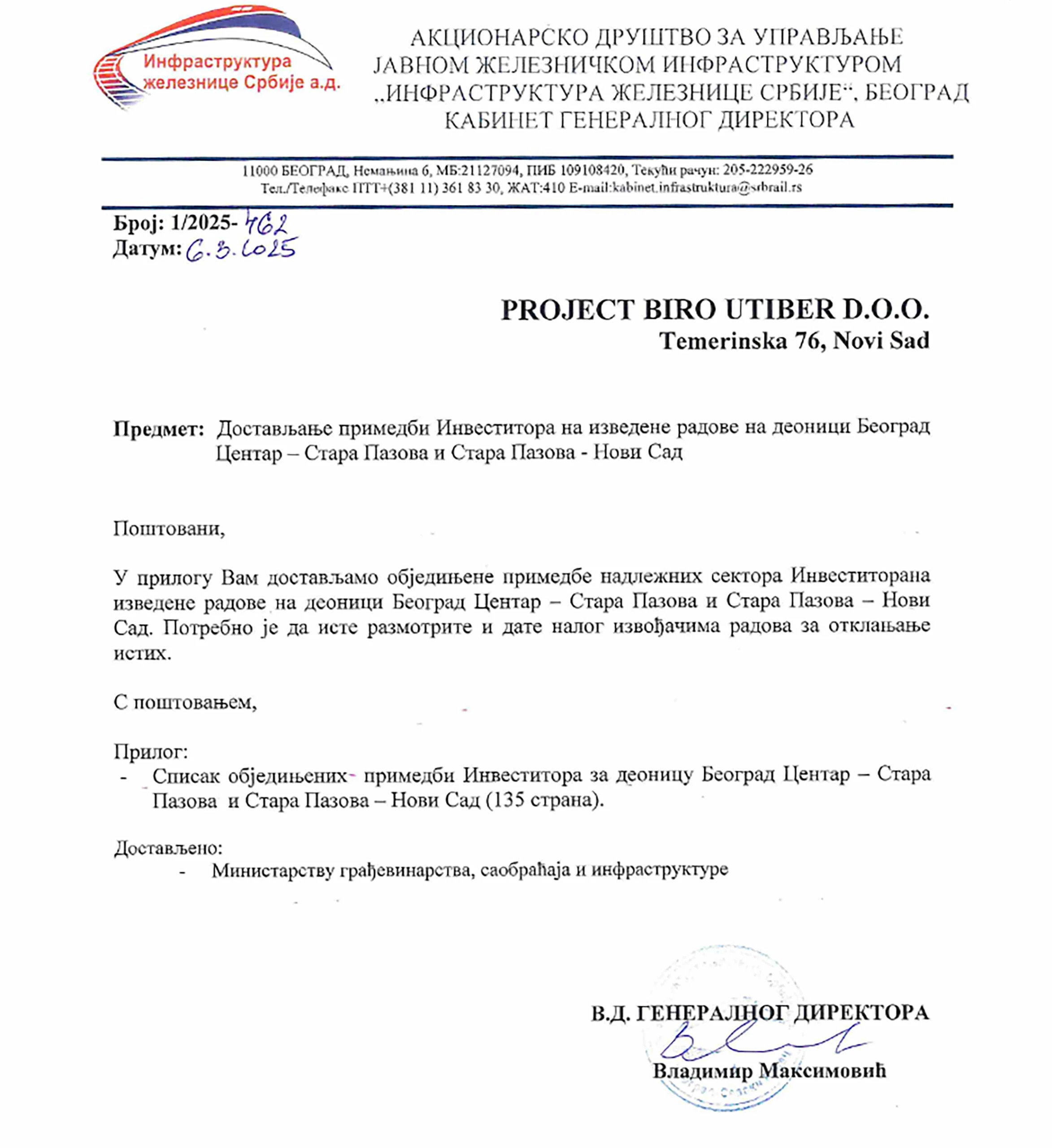
Since the public does not know whether that project documentation was ever done, what we can see is what (didn’t) happen in practice, based on the Railway Infrastructure report from March 6 of this year, which lists numerous deficiencies on the section of the high-speed railway from Belgrade to Novi Sad, on which trains will run from March 2022, and a detailed report on the current state of the Hajdin bridge and the Bežanij tunnel, from which it can be concluded that they were not the subject of works. Coincidentally or not, after the publication of this Report, the Government dismissed the then Acting Director of Railway Infrastructure, Vladimir Maksimović.
Essentially, if the previously planned works on the Hajdin Bridge and the Bežani Tunnel were omitted, it would mean that the originally estimated price of modernization and reconstruction of that part of the railway of 314 million euros should have been reduced by several tens of millions, and according to some estimates by around 20 to 30 million euros. Therefore, in addition to security, the question arises as to where this huge amount of money ended up.
The costs of the second section increased by 12.6 percent, and the first by as much as 38 percent
Although the comparative analysis of initially contracted costs and works on the first and second sections, submitted to the head of Vučić’s cabinet, states that the construction of the first section of the railway cost 314 million euros or 345 million dollars (at the average exchange rate for 2016), the newly published documentation reveals that the costs of that section are significantly higher. According to the data of the Ministry of Construction, Transport and Infrastructure as of July 31 of this year, the commercial contract for this section was signed on November 5, 2016, and the price of $367.4 million was contracted by $23 million.

However, it doesn’t end there either, because according to data from the Infrastructure of Railways of Serbia from December 2024, the construction costs of that section, with seven annexes, grew to 474.5 million dollars, and there are additional claims of contractors of 769,000 dollars. In total, therefore, 475.3 million dollars. This means that each kilometer of that railway cost an average of 13.8 million dollars, which is even 38 percent more than stated in the comparative analysis submitted to the head of Vučić’s cabinet, which states that the average price per kilometer was 9.1 million euros or 10 million dollars.
Based on the same document, it can be determined that the second section of the railway , instead of 943 million euros or 1.1 billion dollars (at the average exchange rate for 2018), so far, including four annexes to the Commercial Agreement, cost 1.25 billion dollars. This corresponds to a price of 11.6 million dollars per kilometer, which is 12.6 percent higher than that stated in the comparative analysis, according to which the price per kilometer of the second section was 8.7 million euros or 10.3 million dollars.
Although the planned works on the Hajdin Bridge and the Bežani Tunnel were not completed, the cost of the reconstruction of that part of the railway was not reduced by 20 to 30 million euros, so in addition to the safety issue, the question arises as to where that huge amount of money ended up.
The comparison with the 44.44 kilometer long section of the railway from Stara Pazova to Novi Sad, which was built by the Russians, is especially striking. Annex 3.1 from 2016 contracted the construction of the 2.24-kilometer-long Čortanovci tunnel under Fruška Gora and the accompanying 3.3-kilometer viaduct for 337.6 million dollars, and Annex 3.2 from 2017 agreed to pay 255.6 million for the construction of the open railway from Stara Pazova to Novi Sad. In addition, according to Infrastructure data, Annex 2 was signed in 2020 worth 58.7 million euros, which at the average exchange rate of that year corresponds to the sum of 66.9 million dollars.
In total, therefore, that section cost 660.1 million or 14.9 million dollars per kilometer, with the fact that the Russians built one tunnel and a viaduct 3.3 kilometers long on that section, while on the first part of the railway from Belgrade to Stara Pazova, the Chinese did not have to build any tunnel or viaduct longer than 1,600 meters. Therefore, for the sake of comparability, if Annex 3.1 and the cost of the tunnel and viaduct near Čortanovaci are excluded, it turns out that a kilometer of railway on the section from Stara Pazova to Novi Sad cost 7.3 million dollars, which is almost half the price of the first section, which was built by the Chinese from Prokop to Stara Pazova.
All in all, although some of the planned works were missed, the cost of building the section from Belgrade to Stara Pazova was not reduced by a single dollar. Moreover, in relation to the comparative review, once submitted to the head of the Cabinet of the President of Serbia, all costs are quite inflated and there seems to be no end in sight. Robbery of citizens continues even after the tragedy in Novi Sad. In Serbia, even life seems to have a price. It is even worse that that price is charged by those who are responsible for the loss of 16 human lives under the burden of the collapsed canopy and who, despite everything, announce that the first train on the new railway from Novi Sad to Subotica will leave already “in about fifteen days” .