The organiser of Expo 2027 Belgrade has published a website called Expo Myth Check: thirteen cards, each with a myth printed on the front and the official truth on the back. Click a card, and the criticism flips over into a rebuttal.
What were the cards for? Not to address detailed criticism, but rather to reassure a broader audience that concerns have been resolved. They look built for the much larger audience that has heard there is a controversy and would like to be told it has been handled: thirteen worries, thirteen answers, a card that flips and closes. By mixing together concerns raised by the Fiscal Council, EU Parliament, the UN Working Group and Transparency Serbia with a rumour from an AI-generated video, they are trying to diminish the former and spin the narrative to the absurd. This is gaslighting. However, by responding publicly, the organisers have made a number of concrete claims that can now be independently examined and verified. We therefore examined each of those claims in turn.
EXPOsed Reality Check explained
Expo will cost the citizens of Serbia 18 billion euros
The 18 billion euros is not the exhibition. But the one who attached it to the exhibition was not a critic – it was the government.
“Leap into the Future – Serbia EXPO 2027” was originally named for the Expo year, timed to the Expo deadline and sold under the Expo banner. It bundled more than a hundred projects across the country, from railways to a dolphinarium, into a single programme whose brand borrows from the exhibition. After three years of presenting infrastructure projects as if they are brought by Expo, the organiser is now blaming the audience and their memory.
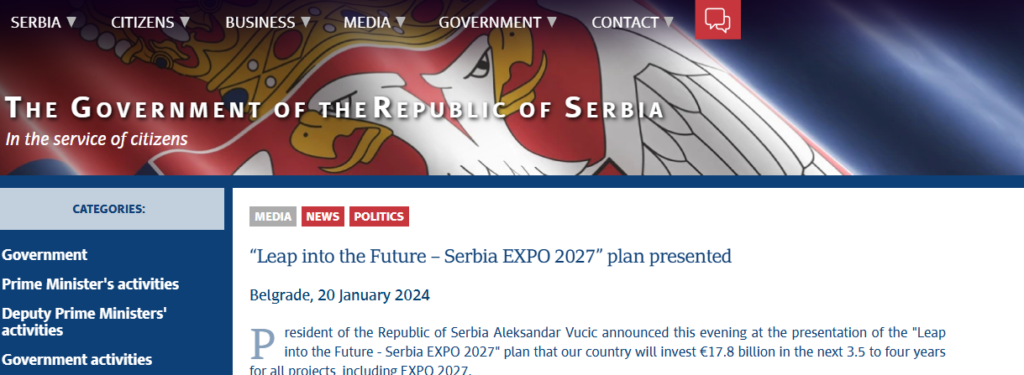
When President Vučić launched the programme on 20 January 2024, it was named “Skok u budućnost – Srbija EXPO 2027”, Leap into the Future – Serbia EXPO 2027: 17.8 billion euros, 323 projects, five categories, of which Expo 2027 was one. The card above calls it “Skok u budućnost – Srbija 2027”. Somewhere between the launch and the myth-check, Expo was taken out of the title of the programme that had been built around it. It has gone from the address as well: the programme now lives at srbija2027.gov.rs, under the shortened name, where Expo 2027 appears as one of six thematic areas alongside infrastructure, industrialisation and modernisation. The government’s own site, in other words, still files the exhibition as a component of the programme – which is the arithmetic the card is disowning.
The changing branding, scope and financial figures suggest a strategy that remains unclear. As the project’s definition and cost estimates continue to shift, the line between Expo and the wider investment programme becomes increasingly blurred.
The programme is not, in any case, a document. In February 2026 Nova ekonomija reported that “Skok u budućnost” is neither a plan nor exists as a document, though citizens are paying for it, and set the circulating values side by side. The launch announced 17.8 billion euros, which the finance minister rounded up to “around 18 billion” across more than 300 projects. Totalling the 52 projects in the government’s Revised Fiscal Strategy for 2026 produces 2.2 trillion dinars, or 18.9 billion euros, spent by 2025 and planned for 2026; carry the same document’s projections through to the end of 2028 and the figure reaches 21.7 billion. A later finance ministry document gives 14.6 billion. The programme’s own official website lists 14.5 billion – without specifying whether they are dinars or euros. Marko Milanović of the Fiscal Council described how the contents move: “Sometimes they put the Morava Corridor in, sometimes not.” The National Stadium, he noted, was moved out of Expo once its costs began to climb – a reclassification in the accounts rather than on the ground, where it remains inside the Expo law and the Expo spatial plan.
The 1.29 billion sum isn’t consistent either. In June 2026, the Serbian Fiscal Council put Expo and its associated projects at around 3.4 billion euros, and noted that the estimates keep moving without clear justification. The National Football Stadium climbed from 575.92 to 639.57 million euros in five months. The line infrastructure and heat source project went from 345.55 to 532.83 million.
The 1.29 billion also leaves out what the money costs. The government has already issued eight-year bonds worth 150 billion RSD (1.3 billion €) at an interest rate of 7%, the most expensive borrowing route available to the state. Interest alone, the Fiscal Council calculated, will run to about 700 million euros, “an enormous expense”, with more borrowing still to come. Radio Slobodna Evropa reported that on current plans Serbia will be paying off the Expo centre for roughly thirty years.
Finally, in September 2025, the government hired the consultancy Louis Berger through public procurement, at 68.9 million dinars, and the findings were presented in August 2026 — three years after Serbia won the bid, and long after the money was committed. Its figure for what the state is putting into Expo is two billion euros, also way above 1.29 that the card mentions.
EXPOsed Reality Check explained
The National Stadium is part of the Expo 2027 project
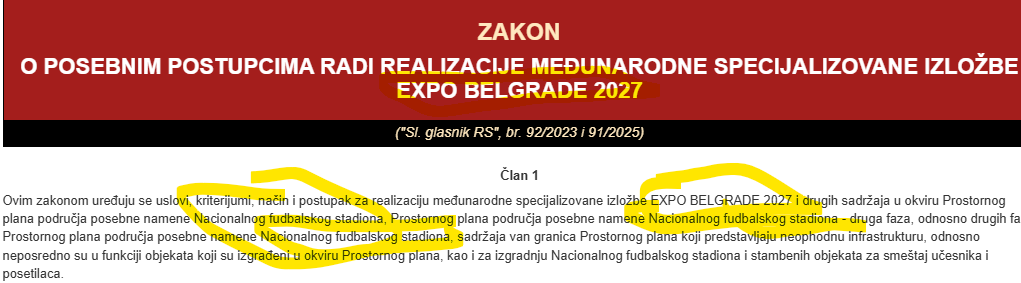
They share a law: Article 1 of the Law on Special Procedures for the Implementation of the International Specialized Exhibition EXPO BELGRADE 2027 says that it regulates the conditions and procedures for the exhibition “and other content within the Spatial Plan of the Special Purpose Area of the National Football Stadium” – the stadium’s plan is named four times in that single sentence – “as well as for the construction of the National Football Stadium and residential buildings for the accommodation of participants and visitors”. The stadium is in the law’s first sentence, listed as one of the things the law exists to build.
They also share a planning instrument, though not in the direction the answer implies. The special purpose spatial plan at Surčin began as the stadium’s own: an early public review in April 2019 over 114 hectares, a draft on public display in October 2021, adoption in early 2022 covering roughly 119 hectares, of which about 32 were the stadium plot itself. The first of those steps predates Serbia’s Expo bid altogether, and all of them predate the award of the hosting rights in June 2023.
Afterward, the stadium plan expanded to include the exhibition. A second phase took it to 167 hectares in 2023. A third reached almost 350 hectares and divided it: 83 hectares of Expo exhibition space, 31.4 for the stadium itself, 23.37 of accompanying commercial content, 63.5 of supporting sports facilities, and housing for a projected 4,500 residents once the exhibition is over. A fourth, in February 2025, took the whole thing to 813.6 hectares – about seven times the first plan – and the strategic environmental assessment for all of it is still filed under the stadium’s plan.
The Expo law does not merely coincide with that document, it is actually written on top of it. Article 1 states that the statute governs the exhibition “and other content within the Spatial Plan of the Special Purpose Area of the National Football Stadium”, and Article 3 defines “the Spatial Plan”, for the purposes of the entire law, as the Prostorni plan područja posebne namene Nacionalnog fudbalskog stadiona and its second phase. The exhibition’s governing statute places it within the National Football Stadium’s spatial plan.
And they share a bond issue: the 150 billion dinars raised for the first phase of financing was borrowed for Expo with the National Stadium together. From 2.2 to 2.9 percent of GDP, it found the largest increase in expenditure fell on the investment line, and that it could be “almost entirely explained by two projects, EXPO 2027 with the construction of the National Stadium, and the purchase of Rafale aircraft”. Two projects, not three. The stadium sits inside one of them.
The separation is real in only one direction. The stadium is Expo when the legacy is being advertised, and not Expo when the 1.29 billion is being defended.
EXPOsed Reality Check explained
The lex specialis was adopted in order to circumvent the law
France did pass a law to speed up permitting for the Paris Olympics – and kept the building permits, the construction supervision and the completion declarations, streamlining the process rather than removing its layers. Japan passed no special law for Osaka, adapting existing temporary-structure rules under Article 85 of its Building Standards Act, which still require formal permits with detailed safety and evacuation requirements. Both findings come from an N1 fact-check published in March 2026 in direct response to Expo 2027 director Danilo Jerinić making this same comparison.
Article 14 switches off the Law on Public Procurement for the state companies acting as investors and lets them write their own rules instead; the government supplied a regulation in its place in February 2024. Public review of planning documents was cut from the statutory 30 days to 15. Procurement thresholds rose eight to twelve times. Appeals were abolished.
It was also passed in breach of the law governing how laws are passed. Article 77 of the Law on State Administration requires public participation in drafting. The Expo law arrived without public debate or consultation, and without any published analysis of what it would mean for expropriated landowners, corruption risk, or construction oversight.
Transparency Serbia filed an initiative against Article 14 in January 2024, arguing procedural violations and a conflict with Serbia’s Stabilisation and Association Agreement with the EU. Despite repeated requests for urgency, the Constitutional Court still has not ruled. Meanwhile, contracts worth hundreds of millions of euros have been signed.
The 2025 amendment then went further in the same direction, allowing buildings to be commissioned on a technical inspection report for up to 24 months before a use permit, and deferring environmental approval from the building permit stage to the use permit stage – that is, until after the building was used for 2 years.
In June 2026, the UN Working Group on Business and Human Rights recommended that Serbia withdraw or amend the whole framework, citing “exceptional legal and administrative arrangements that weaken ordinary safeguards,” and the recommendation wasn’t applied. Every procedure the law removed was a standard. Saying the law was not written to lower standards simply does not stand.
EXPOsed Reality Check explained
Expo contracts go to pre-selected firms
The advertised regulation exists only because the safeguard was taken away. It replaced the Law on Public Procurement for Expo-related entities, yet according to Transparency Serbia, it lacks the key protections of the system it replaces, including minimum bidding deadlines, the recourse to the Republic Commission for the Protection of Rights, or appeal.
There was an astonishing lack of competition in the past EXPO procurements. Transparency Serbia examined 72 of them and found that in 86 % of them the contract went to the only acceptable bid received. The average number of bids submitted was 1.56. The average number of valid bids was 1.19. Total value: 39.47 billion dinars, roughly 330 million euros.
Works on the National Stadium and its associated facilities, worth over 207 billion dinars, went to Power China by direct contracting. That is the pattern across the wider programme: the major jobs are handed to Chinese state-owned enterprises – China Railway International, China Communications Construction Company, PowerChina – through intergovernmental agreements and direct negotiation, without competitive tendering. Radar counted some 12 billion euros of work entrusted to companies from China by the current government.
The organiser answers a question about who wins with an answer about where the result is posted. They do not talk about how much competition actually happened. An average of 1.19 valid bids across 72 procedures is not a good indication on it.
EXPOsed Reality Check explained
Serbia is paying other states to take part
The argument claims that paying for the participation is an established practice, and mandatory.
What the response leaves out is how much Serbia pays – 42 million euros. Forbes Serbia established that the state has committed a maximum of 4.9 billion dinars to support the participation of certain countries and organisations, and the categories of spending are exactly the ones the organiser lists: pavilion fit-out, staff, promotion, National Day.
While participation support programmes have precedents in countries such as Japan, the UAE, Kazakhstan, Italy, and China, the Serbian case differs in one important respect. The recognition dossier has not been published, and the feasibility study containing the cost–benefit analysis has been made available only in a limited form to journalists rather than to the wider public As explained in other fact checks, because of this lack of transparency, it remains unclear whether this investment can be justified.
EXPOsed Reality Check explained
Expo is a party project
It is true that the people leading the EXPO project are not members of the Serbian Progressive Party (SNS). However, in Serbia, the boundaries between the Party, the State, and the President have become increasingly blurred. From the Freedom House report: “Vučić has remained the dominant figure in government despite the presidency’s limited executive powers under the constitution, creating a de facto presidential system.” and it further observes that the SNS has “manipulated the timing of snap elections, exerted pressure on independent state institutions, bused in voters from neighboring countries or districts, and mobilized public resources to support its campaigns.” In such a political environment, major public projects cannot be viewed in isolation from the broader distribution of power. When decisions are concentrated within a ruling party, and increasingly around a single individual, the key question is not simply whether a project is legal or procedurally correct, but whom it ultimately serves. The June 2023 vote in Paris settled the question of who would host EXPO 2027. It did not settle whether citizens of Serbia wanted to host it, or whether the project reflected a national consensus capable of uniting the country behind it.
The simplest proof is the civil mobilizations:
- 120,512 citizens have signed “STOP corruption, cancel the Expo”, which asks the BIE to take the exhibition away from Belgrade, and
- 6,411 citizens put their names to a formal notice to the BIE Secretary General setting out legal violations, corruption and safety risks.
Those are not the figures of a project gathering the country around a common goal. They are the figures of a project a great many people would like called off.
The civil sector went past signing. Two organisations exist that would not exist but for this exhibition. EXPOdiraću was formed by students and teaching staff at the Belgrade Faculty of Architecture, the same faculty that produced the study reconstructing the project’s finances from the fragments the state has released. The second, this website. A national project of strategic significance does not ordinarily produce a nemesis at home and another one abroad.
Who does participate? The recognition dossier is a business secret. The economic study went unpublished for three years. There is still no list of the companies building the project. And where money was short in adjacent sectors, the condition attached to it was EXPO: two parallel funding streams at the Ministry of Culture in 2025, the Expo competition offering awards up to eight million dinars, and a Labour ministry requiring projects for people with disabilities to link themselves to Expo participation. Ministry of Education put the EXPO visit on school calendars. Obviously, the country needs to resort to coercion in order to get domestic organisations to participate.
EXPOsed Reality Check explained
The Expo documentation is secret
The BIE’s position is the reverse of the one implied here. It does not itself release a recognition dossier, but it leaves the organiser free to share the contents, in whole or in part, with anyone it chooses. The confidentiality is the EXPO company’s decision, and Serbia went further and declared the financing chapter a business secret. The Expo company’s stated reasoning is that the information has strategic and commercial value only for as long as it is not public.
Some of it is properly confidential. Sponsorship pricing for example are nobody’s business. Serbian citizens and taxpayers, however, are directly concerned about the financial plan of a project funded by public bonds at 7 percent. Furthermore, the economic study that might have justified the spending was commissioned in September 2025 and presented in August 2026, three years after the decision it could have informed, so Serbian people didn’t have the privilege of being informed, or the opportunity to voice their concerns.
The measure of it is that independent researchers have had to rebuild the project from fragments. The University of Belgrade Faculty of Architecture study “Invisible mechanisms of misuse of public resources” exists because the primary documents do not circulate. So does Ministarstvo prostora’s handbook on avoiding participation, which reads the Expo process as a case study in how to hold a consultation without holding one.
EXPOsed Reality Check explained
Volunteers will replace paid workers
Expo is recruiting more than 20,000 volunteers across 48 different positions, each of them committed to a minimum of fifteen days across a three-month exhibition. The card’s assurance that volunteers do not perform work for which professionals are engaged is an assertion about that arrangement, not a disclosure about it. No staffing plan has been published showing if there is an overlap: which of the 48 functions are also filled by paid employees, or how many paid employees fill them. Nobody outside the organisation can tell whether the line it describes exists.
On 5 May 2026, Finance Minister Siniša Mali announced that students volunteering at Expo could earn ECTS credits; the government adopted the conclusion the following day, awarding one to three according to hours served.
The concern is not student volunteering per se, but the lack of transparency surrounding the programme. Students are being offered ECTS credits for work whose academic value, learning outcomes, and relevance to their studies have not been clearly explained. Given that universities reportedly were not consulted on the decision, it remains unclear whether the programme serves students’ educational interests or simply provides Expo with a pool of unpaid labour. At the very least, it is difficult to see how a scheme that awards university credits can be developed without meaningful involvement from the universities themselves. Until that process is clarified, questions about its academic legitimacy remain unanswered.
EXPOsed Reality Check explained
Everything built for Expo will be demolished afterwards
The response talks about “the new Belgrade Fair”, but the old one still stands. Hall 1, completed in 1957, was for years the world’s largest domed structure. It is being cleared for the expansion of controversial project – Belgrade Waterfront, with Surčin named as its replacement – despite protests from expert professional bodies and students in a blockade demanding it be protected as cultural property. On the question of demolition, Expo’s clearest answer is demolition.
The reuse narrative remains unsupported by any transparent report or cost analysis. Officials have claimed that the modules could be transformed into 3 schools and 3 kindergartens, or 22 gyms. However, no published documentation identifies where they would be installed, how much dismantling and regulatory compliance would cost, who would fund the process, or event who would carry out the work. This is a particularly relevant question given Serbia’s limited experience (and skills) with circular economy projects and the lack of a mature ecosystem for large-scale dismantling and material use. Consequently, claims that reuse would be more economical than new construction lack a credible evidentiary basis, especially given the absence of evidence that the modules were designed for disassembly and reuse. Taken together, the absence of a financial roadmap, identified delivery partners, and a clear end-use strategy suggests that the reuse commitment currently functions more as a communications narrative than as a substantiated project.
Some of the legacy will not exist while the exhibition is on: the theme park, dolphinarium and aquatic center will not be started before 2028, and the 30 new BG Voz trains have slipped to late 2029.
The National Stadium was argued not to have usage potential even before EXPO was in the books. In October 2017, the Spanish practice Fenwick Iribarren Architects, designers of 3 Qatar 2022 stadiums, recommended Ada Huja; Belgrade chose Surčin, where they warned the stadium would be used about 30 days a year and stand empty for the other 336.
What cannot be undone is the land use. Of the 813.6 hectares, 604.32 – 74.3 percent is high-grade farmland inside the sanitary protection zone of a water source supplying roughly 30 percent of Belgrade’s drinking water. Planned green space: 3.09 hectares. And 2,300 deep piles went into a Zone III protection area before the cumulative hydrological study that the stadium’s own environmental impact report called necessary.
EXPOsed Reality Check explained
Visiting Expo will be compulsory for schoolchildren
The controversy stems from a Ministry of Education rulebook that scheduled a one-day visit to Expo 2027 for schools. Following public criticism, the Ministry stated that participation would be voluntary and left to each school’s discretion. However, civil society groups noted that the rulebook itself still includes the visit. This led to calls for the Expo visit to be removed from the calendar and concerns that children were being used to promote the event. More broadly, questions remain about transparency: despite references to guidance provided to schools, no public instructions, budget estimates or implementation plans have been disclosed, leaving key costs such as transport, meals, insurance and staff expenses unexplained.
EXPOsed Reality Check explained
Buildings will open without use permits
To repeat the words of the organizer: In accordance with the special legal framework for the organisation of Expo, certain facilities may be put into operation on the basis of a positive report of the Technical Inspection Commission, before a use permit is issued. So Myth is definitely not a myth.
On whether it is OK to skip the use permits, let’s remind ourselves Serbia’s recent history of infrastructure projects entering operation before all approvals and oversight were in place: On 1 November 2024, the canopy of the reconstructed railway station in Novi Sad collapsed and killed 16 people, in a building that had gone into service without proper permits or oversight. This does not inspire confidence.
And the practice of infrastructure running years before getting the use permit continues. Belgrade’s Prokop station has taken passengers from 2023 until 2025 without a licence and without meeting fire safety requirements, with cracks in the lower zone of platform beams and reinforcement found to be thinner than specified. Six stations on the Belgrade–Subotica line run on partial permits, Subotica itself rated “1 – unsatisfactory” by ministry inspectors. The Pakovraće – Požega motorway opened without an operating permit or technical inspection approval, its Munjino Brdo tunnel troubled by landslide and water. The Belgrade Tower, opened 2 years ago, still has no use permit.
The myth card states that similar models were applied in the organisation of other major international events, but doesn’t state which events or which models. As N1 article articulated with the examples of EXPO 2025 in Osaka and Summer Olympics in Paris, neither of these countries waived their standard permitting requirements (France kept its supervisions and its completion declarations and Japan passed no special law at all)”
EXPOsed Reality Check explained
Expo will bring Serbia no economic benefit
The official estimates have since arrived. The study partially presented to the reporters in August 2026 finds 9.1 billion euros of gross added value, 359,000 jobs and 3.82 billion euros in tax – 1.91 dinars back for every dinar the state puts in. But there is no explanation on where the numbers are coming from. When Forbes Serbia asked Expo 2027 d.o.o. on 20 August for the procurement report and the documents the winner submitted to prove it qualified, nothing came: no documents, no reply, and no notice of delay within the 15 days the Law on Free Access to Information allows. The company is wholly state-owned and bound by that law.
Furthermore, the study came three years after the bid was won, too late to inform the decision. Its return is dated 2037 and depends on a decade of successful management after the exhibition, which itself loses about 500 million euros. And its 1.65 million foreign visitors, spending up to 460 euros a day, conflict with the fact that specialized exhibitions typically have 8 to 12 per cent of their visitors from abroad.
Finally, the official answer’s own figures are simply not true. The 1.1 billion “total economic effect” counts turnover, much of it displaced from elsewhere in the economy, not return. The 1.5 percentage points of GDP is a one-off that lifts 2027 and falls away in 2028. It also conflicts with a cost that the Fiscal Council puts on it: about 3.4 billion euros, plus roughly 700 million in interest on the first tranche.
There will be some financial benefit from a three-month international exhibition. But the case for it rests on a payout in 2037, a visitor mix that an international experience does not support, and a study whose procurement file the organiser is withholding in breach of the law.
EXPOsed Reality Check explained
A company owned by Anita Haradinaj received land preparation contracts
Strictly, nobody can confirm or refute this. Serbia has never published a list of the companies working on Expo. When the Center for Investigative Journalism of Serbia (CINS) set out to identify them, it found that information on who is working on the country’s most important state project remains opaque, and had to assemble its own database from direct inquiries and collected documents. A denial that cannot be checked against a contractor list is not quite the same as a refutation.
The more useful observation is that the reader has no reason to care. Anita Haradinaj has not been charged with anything. She is the wife of Ramush Haradinaj, who was tried at the Hague tribunal and acquitted – twice. Even if he was convicetd, nothing attaches from a husband’s prosecution to a wife’s business affairs.
What the reader should care about is who did get the work, which CINS spent months establishing. It identified more than 200 companies on the Expo site, and among them a recurring pattern of owners with criminal convictions or close family ties to organised crime. Makiš Beton, which took about 70 percent of its 2.1 billion dinars of 2025 revenue from Expo, is co-owned by Vujadin Krstić, convicted of aiding the killer of Željko Ražnatović Arkan; its majority owner is the sister of a man CINS links to the governing party and the Partizan ultras. Stone for the national pavilion came from a company whose owner was sentenced in Liechtenstein over a 2004 Pink Panthers theft. Site cleaning went to a company owned by Đorđe Prelić, convicted of the murder of the French football fan Brice Taton. Sand was excavated by a firm owned by the son of Dejan Milenković “Bagzi”, of the old Zemun and Surčin clans (cartels active in the 2000s, associated with the assassination of the Serbian Prime Minister Zoran Đinđić), and supplied by a road company whose owner CINS associates with Ljubiša Buha “Čume”, another former leader of Surčin Klan.
Some of those are convictions and some are family relationships, and the distinction matters – it is the same distinction the Haradinaj card ignores. But these are documented facts about companies demonstrably working on Expo, established by journalists who had to reconstruct the contractor list themselves because the state would not publish it. That is the story the thirteenth card could have been about. Instead, the claim is about a video circulated on a Serbian Telegram channel in which the footage and audio had been generated with artificial intelligence. It appears as if this card was added just to have something truly easy to refute, yet bombastic, in the same time throwing shadow at the legitimate concerns that they tried to spin around with the previous cards.