The Chinese are building – Serbian debt. The current government entrusted companies from China with jobs worth 12 billion euros.
Radar, December 2025
Link to the original article: https://radar.nova.rs/ekonomija/kineske-investicije-a-dug-srpski/
Only three major players, CCCC, CRIC and CRBC, are engaged in projects worth more than 10 billion euros. They tied Serbia to Exim Bank, which finances these works, and then part of that money ends up in the accounts of companies whose owners are close to people from the top of the government and SNS
Six months, that’s all the “eternal” Hongqi Bridge in the Chinese province of Sichuan lasted before it collapsed on November 11 this year. Instead of an engineering triumph, it remains a ruin, while Beijing is likely to chalk it up to “geological unpredictability.” But the statistics are clear, it was one of dozens of bridges that have collapsed in China since 2011, another footnote in a system that does not admit mistakes.
Can that terrible image from Sichuan become part of the future that the citizens of Serbia are currently financing? As tens of billions of euros in loans for the construction of road and other infrastructure mature by 2044, the question is no longer just the price of all those projects, but whether the roads and tunnels whose construction we pay for will survive the basic warranty period.
The story of Chinese penetration into Serbian infrastructure did not emerge overnight. Its chronology starts back in 2011, when the China Road and Bridge Corporation (CRBC) entered our market via Pupin’s Zemun-Borča bridge, a project worth 260 million dollars. At the time, it was hailed as a symbol of the new partnership and the first bridge on the Danube in decades, but it was actually a test model for a financial arrangement that would soon become the norm.

No tender and no competition
Already in 2014, at the summit of 16 countries of Central and Eastern Europe and China, with China Railway International Company (CRIC) and China Communications Construction Company (CCCC), it was agreed that this consortium would be hired for the modernization of the railway from Belgrade to Budapest. The contract for the first section from Belgrade to Stara Pazova was signed in 2017 in Beijing, and a year later in Belgrade the commercial contract was concluded for the second section from Novi Sad to Subotica . Meanwhile, the price of the railway, thanks to numerous annexes, exceeded 1.6 billion euros. Namely, from well-informed sources , Radar learns that from the beginning of 2019 to the end of October of this year, 189.1 billion dinars were paid from the Serbian budget to contractors on the Serbian-Hungarian railway.
Soon after, Shandong Hi-Speed Group takes over the key sections of the “Milos Veliki” highway, while CRBC receives a new contract for the construction of the highway section from Surčin to Obrenovac. Since 2018, the same Chinese companies, without a tender or competition, through an interstate agreement that bypasses the Law on Public Procurement, have been awarded the section of the highway from Preljina to Požega, a job worth 450 million euros, with difficult geology and several missed deadlines.
1.6 billion euros
or 189 billion dinars were paid from the Serbian budget for the Serbian-Hungarian railway until November of this year
Then follow even more valuable contracts. First, for the Fruškogorsk Corridor at 606 million euros, and then for by far the largest communal project, “Clean Serbia”, worth as much as 3.2 billion euros. And that work was entrusted to the already well-known partner, CRBC, again through direct negotiation.
The new jewel on the Chinese crown is the reconstruction of the high-speed railway from Belgrade to Niš, and the contracted value of that project is 2.7 billion euros. All in all, in just 13 years, until November 2025, deals worth more than 12 billion euros have been contracted with just a few Chinese state-owned companies.

CRBC has been present in Serbia since 2010, and based on the numerous jobs for which it was engaged, it could be concluded that, in parallel with the bridges, tunnels and sewage infrastructure within the “Clean Serbia” project, the company also managed to build a solid financial connection, stronger than concrete, between Serbia and the Chinese Exim Bank, which provides loans for all large infrastructure projects for which the local government hires companies from that country.
At the same time, CRIC, as part of Chinese state railways, became the master of Serbian railways. That company participated in the construction of almost every kilometer of domestic “high-speed railways ” and through projects worth hundreds of millions of euros, became an inevitable partner of the Government of Serbia and the state-owned enterprise Railway Infrastructure of Serbia.
2.7 billion euros
the price of the reconstruction of the high-speed railway from Belgrade to Niš was contracted, and that work was entrusted to Chinese companies
The third major player is CCCC, whose “daughter-company” CRBC is an integral part, but in Serbia this umbrella, parent company also acts independently. For a long time, the “silent brother” on Corridor 11, in the meantime, has strengthened its position on the local market and in the last four years alone, it has achieved total revenues of more than 69 billion dinars or almost 590 million euros, with the fact that for the last two years in the business books it shows a net loss, which in 2023 was slightly more than one million, and last year seven and a half million euros. And since it operates with a loss, it does not even pay profit tax.
To what extent will “Clean Serbia” clean up the state budget
Together, this triumvirate of CCCC, CRIC and CRBC alone is engaged in projects with a total value of more than 10 billion euros. And these are not foreign direct investments, but state affairs, which are financed by borrowing, so the tax payers will have to pay back that debt with interest. Bearing in mind that three Chinese companies are asked practically more for roads, railways and sewerage than the Government of Serbia , the question of whose infrastructure is actually raised logically arises, at least until all the loans for these purposes are returned.
Although CCCC has achieved total revenues of 590 million euros since 2021, in the last two years it has reported a net loss, so it did not even have to pay the state a profit tax
The most expensive item in that financial labyrinth is “Clean Serbia”. Although it is presented as an ecological salvation, the financial structure of that project is inexorable, because Serbia borrowed as much as 85 percent of the money from Exim Bank, and the remaining 15 percent had to be “cashed” in advance, as a down payment for the loan. However, it remains to be seen how much this project will ultimately cost more than the contracted 3.2 billion euros, because all other projects, in which Chinese companies are engaged, are characterized by breaking the originally agreed deadlines. And the total costs grow in parallel with the deadlines.
It all started with the Zemun-Borča bridge, the price of which, with access roads, increased from the initial 170 to 260 million dollars, with the fact that, as in most similar cases, 85 percent of the money for its financing was provided by Exim Bank in the form of a loan. According to the same model, money was secured for the railway corridor from Novi Sad to Subotica, whose contracted value of 1.16 billion dollars was subsequently increased through several annexes.

The Fruškogorsk Corridor, worth 606 million euros, was also financed with a Chinese loan, and the deadline for repaying that loan expires only in 2041. On the other hand, the construction of the section of the highway from Preljina to Požega began with an estimate that it would cost 450 million euros, with the well-informed sources of Radar stating that the contractors had been paid twice as much by the end of October this year, or 933 million euros to be exact, or 109.3 billion dinars.
3.2 billion euros
will cost the “Clean Serbia” project, and the state secured 85 percent of that sum by borrowing from the Chinese Exim Bank
When all these figures are added up, the brutal truth is reached that the value of the projects, including the contracted ones, which have not yet been realized, and were entrusted to this “Chinese trio”, exceeds 10 billion euros. Another fact is even more important, that more than eight billion euros will be provided by Exim Bank for these jobs through loans. In other words, more than 80 percent of our “investment revolution” depends on loans that Serbia will repay decades after the politicians cut the ribbons for the opening of roads, tunnels, railways, bridges…
According to projections for the end of 2025, Serbia’s exposure to Chinese loans, withdrawn and contracted, is approaching the limit of six billion euros, making China one of the country’s largest creditors. Interest rates, once stable and fixed, are increasingly variable in recent contracts, and in unstable financial conditions this usually means even higher installments. Which will not be returned with Chinese money, but with the money of Serbian taxpayers.
Parallel flows of money to Zvonko Veselinović and Milan Radoičić
Chinese loans, which today make up almost a sixth of Serbia’s total public debt, have opened up space for parallel money flows, because part of that money ends up with one of the most controversial business empires in the Balkans. Of the 5.8 billion euros of effective indebtedness to China, a significant part, like a sinkhole, flows into the network of companies connected to Zvonko Veselinović, whose partner was Milan Radoičić, even formally, until the conflict in Banjska at the end of 2023.
That duo was blacklisted by the USA in 2021, and then by Great Britain, due to suspicions that they are involved in organized crime and systemic corruption. Less than two years ago, Radoičić formally left Inkop, the umbrella company within which several other companies operate, transferring his share to the previous partners, the brothers Zvonko and Žarko Veselinović. Their machinery, however, did not stop, but continued to run smoothly.
The construction of the section of the highway from Preljina to Požega began with an estimate that it would cost 450 million, and so far the Chinese contractors have already been paid twice as much money or 933 million euros
The money extraction mechanism meanwhile has evolved from a simple subcontracting role to a full vertical monopoly. Thanks to the interstate agreement, Chinese companies such as CRBC, CCCC and Shandong Hi-Speed are getting multi-million-dollar deals through direct bargaining. Deprived of the inconveniences brought by public procurement and transparent tenders, they use this legal vacuum to hire “verified” domestic partners.
Veselinović’s network, moreover, no longer offers only excavators, because now it also holds raw materials. Previously, the same business network controlled key quarries, including Granit Peščar from Ljig, where Inkop had a 25 percent stake until 2024. Today, those quarries have been formally transferred to companies like Nukleus from Lazarevac, which are still part of the same group, connected to Veselinović, so that Chinese contractors are practically forced to buy stone from them as well.
In practice, Chinese giants delegate the most expensive earthworks and paving to companies controlled by Veselinović. Not only the roofer Inkop, but also the construction giant Novi Pazar put, which, since it was taken over by a duo from the north of Kosovo, has become one of the largest road companies in the country, and Betonjerka from Aleksinac, which was bankrupt until October 2019, when it was taken over by Veselinović and Radoičić, is increasingly involved in state projects.
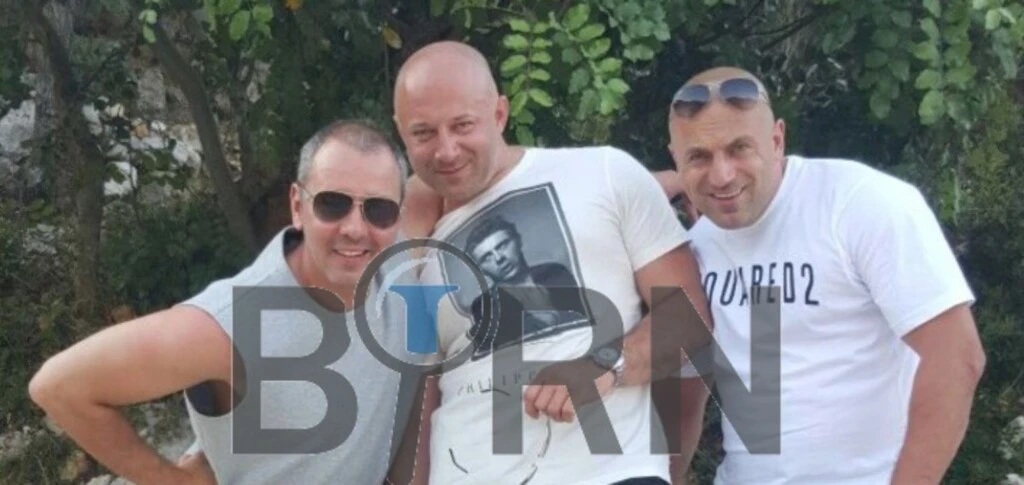
Since Exim Bank provides the money for these projects in the form of loans, it pays it to the Serbian state, it forwards it to the Chinese contractors, and the latter to their subcontractors, the money trail becomes invisible to the budget inspection, so tens of millions of euros end up in the accounts of people who international institutions see as a security threat.
Only two companies owned by the Chinese Ziđin – Ziđin Mining and Ziđin Koper – exported goods worth 1.9 billion euros from Serbia in 2023, while last year exports increased to 2.8 billion, and net profit to 965 million euros.
In just four years, from 2021 to 2024, Veselinović’s Inkop and its related companies, according to publicly available data at APR, achieved a total net profit of 102.4 million euros. Considering the new contracts signed this year, the value of which is almost 84 million euros or 9.8 billion dinars, with an average margin of more than 19 percent, which this group achieves on subcontracting jobs, it is realistic to expect that the cumulative profit could reach 120 million euros by the end of this year.
This money comes directly from the field, from the Laz and Munjino brdo tunnels on the highway section from Preljina to Požega, via the expressway from Iverk to Lajkovac, to the Danube Corridor from Požarevac to Golupec. None of the Chinese companies ever answered questions about the criteria for selecting subcontractors. The Government of Serbia has been defending itself for years with the cynical claim that it “has no insight” into the business decisions of private partners, while Corridors and Roads of Serbia tirelessly sign annexes and payment orders.
The experience of Zambia and Laos with Chinese loans
The quality of works is a special problem. The access roads to the Zemun-Borča bridge already showed serious problems and damage at the joints during 2023, although the project was presented as a symbol of progress. It became an example of how “speed” chases “durability”.
Part of the money borrowed from the Chinese Exim Bank ends up in the accounts of Zvonko Veselinović’s companies, which in the previous four years made a net profit of more than 102 million euros
Even more serious are the problems in the tunnels on the Preljina-Požega section, where seepage and numerous geological challenges were recorded even before they were put into full traffic. The reasons are the same – hasty construction presented as success and saving on materials, which ends up as a profit for the contractor.
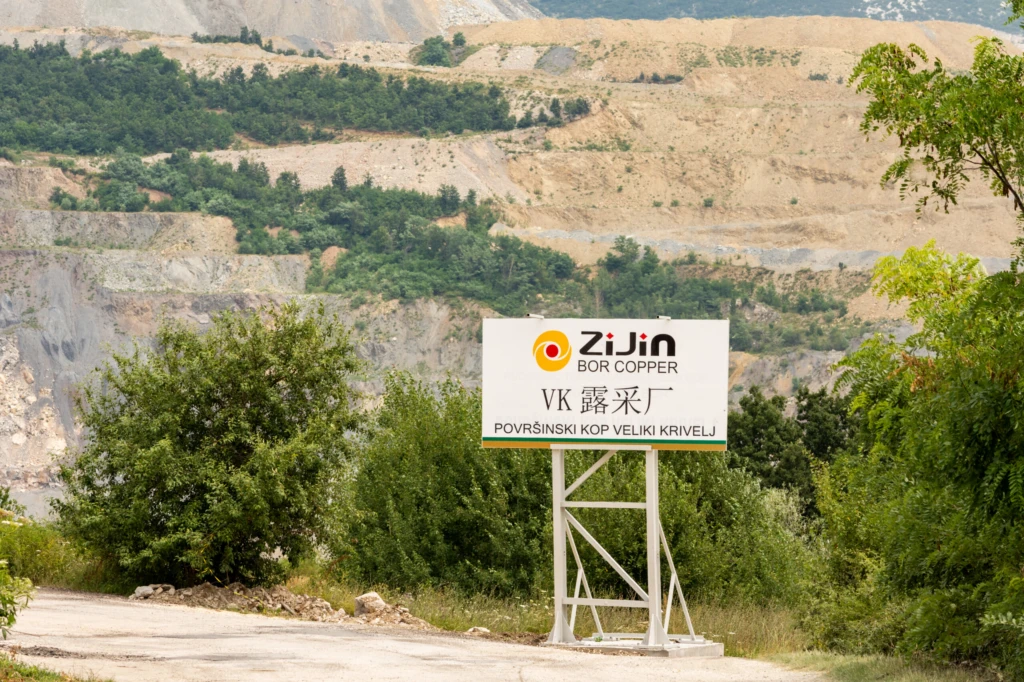
The story of Chinese business in Serbia would not be complete without Ziđin, who took over the Bor mine in 2018 and has since exported copper and gold worth several billion euros from Serbia. Only two companies owned by the same company – Ziđin Mining and Ziđin Koper – exported goods worth 1.9 billion euros from Serbia in 2023, while last year exports increased to 2.8 billion, and net profit to 965 million euros. And while that profit enriches the balance sheets of the parent company from China, the air quality in Bor remains only a footnote in the reports of environmental organizations.
When Zambia could no longer properly service its debt, China openly sought mines as collateral for unpaid loans, and experts warn that Laos could also lose part of its sovereignty, because its debt grew due to the railway being built by CRBC and CCCC, companies also involved in Serbia.
In truth, Serbia is not an exception, but only the latest European episode of a pattern that has been repeating itself for years in Asia and Africa. Zambia felt this in 2020, when it went into default , unable to repay its debt, and soon faced China openly demanding mines as collateral for unpaid loans.
Laos is another drastic example, because the railway from Kunming to Vientiane, which was built by CRBC and CCCC, companies also involved in Serbia, significantly increased the public debt, so experts warn that the country could lose part of its sovereignty through long-term concessions if it is not able to properly settle its debts. They also point out that today infrastructure is used as a tool for reshaping geopolitics, and debt as the ink used to draw these new borders.
The time is slowly coming when the kilometers of roads will begin to turn into years of repayment and when it will become clear that the contracted construction price was only a down payment. The real price will only begin to arrive, on the first of every month, with interest, and it will be paid by generations that have not even been born yet, driving on roads that by then may already be ready for a new reconstruction.
In the end, it all boils down to a simple, but often underestimated lesson in our country, that the country cannot spend more than it creates, nor can it borrow without measure. The construction of infrastructure, which is financed by borrowing, creates the appearance of modernization, which the government uses abundantly to increase its own rating, without asking the price that will have to be paid for it, along with interest. And any decision based only on short-term political gain carries the risk of jeopardizing the country’s sovereignty and stability in the long term. Especially since this semblance of progress will not help to pay the due installments of all debts.