Building perspective
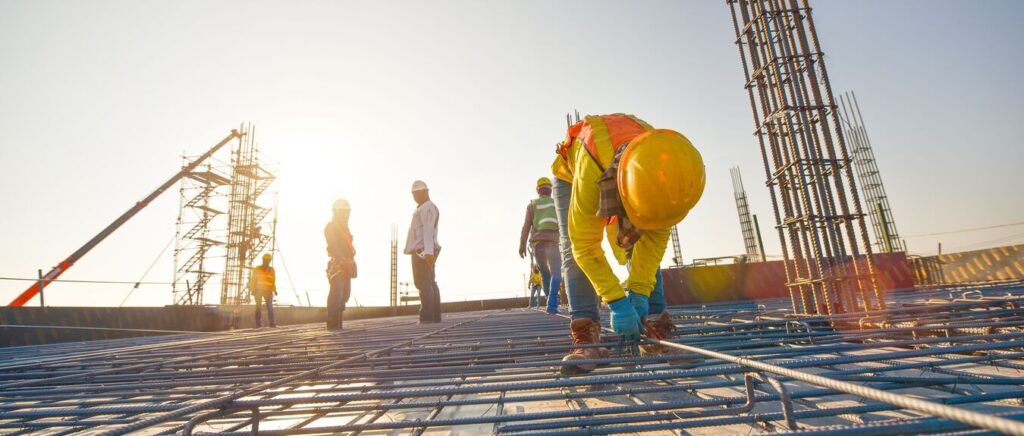
Exploitation of workers
- The Republic Labor Inspection found 56 workers from Turkey and China without work permits at the EXPO construction site in Belgrade.
- The document by The Republic Labor Inspection states: “Due to established illegalities in the field of labor relations and safety and health at work, 17 requests to initiate misdemeanor proceedings were submitted against companies and entrepreneurs, while due to established irregularities,
three decisions were made to prohibit work and five decisions to eliminate irregularities”. - The inspection filed criminal charges against Antares construction and the Belgrade branch of Power China International Group Limited, which have been ongoing for almost a year, CINS reveals.
- Additional legal problem with PowerChina: All Chinese workers without a working permit are employed by the Belgrade branch of PowerChina International Group Limited, which is part of the large Chinese corporation PowerChina. But as a branch of PowerChina, this company does NOT have the status of a legal entity, and is therefore not subject to the law on misdemeanors.
A history of building without a permit: previous indicators and problems
Lack of legislation procedures, alleged corruption, and non-respect of regulation is a constant problem in Serbia.
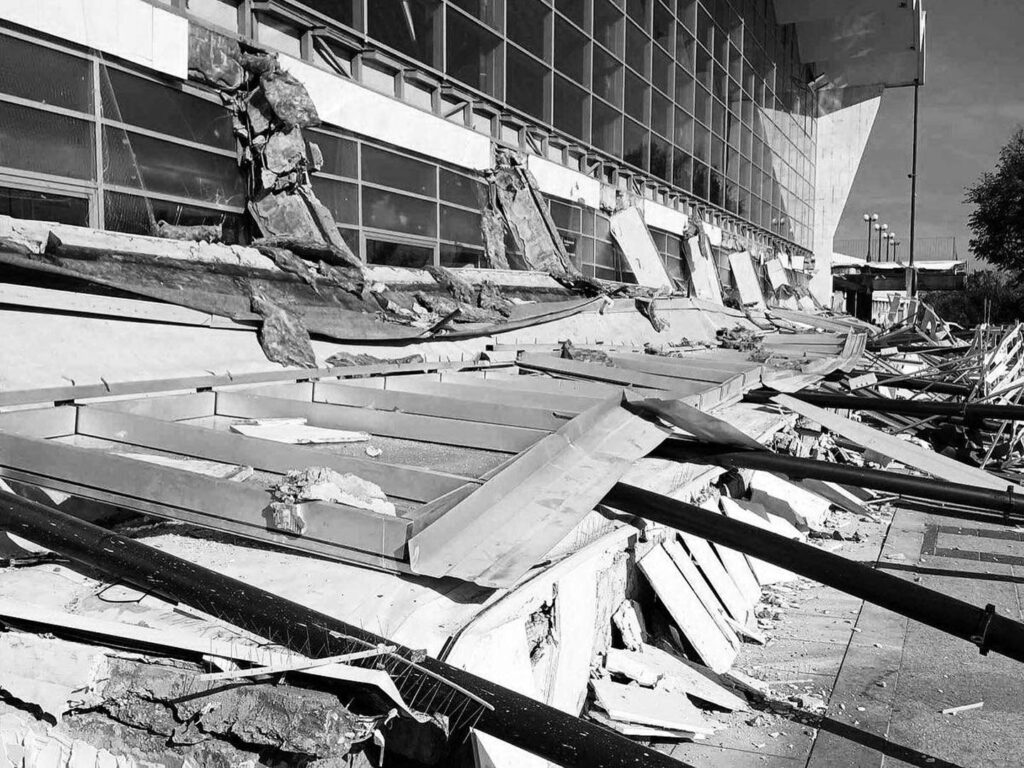
Novi Sad
Canopy fall, Novi Sad railway station
Novi Sad railway station – canopy collapse killed 16 people (November 2024); that facility also lacked proper permits and adequate oversight.
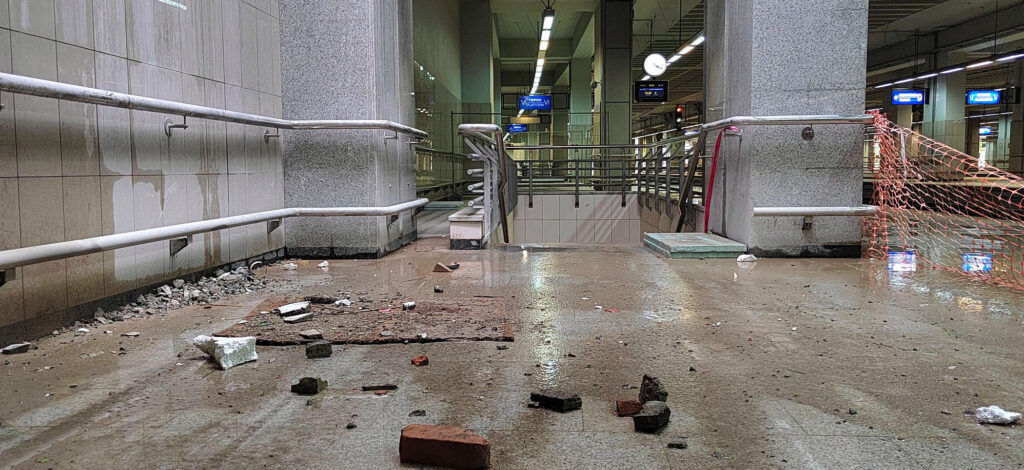
Belgrade
Prokop train station, Belgrade
A central railway station in Belgrade, Prokop, does not have a license and does not meet the fire safety requirements, yet it is allowed to operate regularly and receive passengers from 2023.
- Engineer Edin Drljo warned that the “Belgrade Center” railway station building in Prokop will collapse if the two pillars on which it “stands” fail and appealed that the station should be closed urgently.
- On the platform beams of the Prokop station in the middle of the span, it was observed that cracks appeared in the lower zone. Based on the tests carried out by the materials testing institute from Belgrade, it was concluded that the reinforcement in those beams is smaller than the one provided by the previous project.
- The tunnel should be closed immediately, the damaged poles have only been repaintedi
- Station Prokop without a use permit and technical documentation for fire protection
Across Serbia by road and rail
A major highway opened in Serbia without operating permit and technical inspection response. According to CEOP’s publicly available construction permit database, no operating permit was issued for the section of the Pakovraće-Požega highway (Miloš Veliki).
- This section includes Munjino Brdo tunnel, a problematic spot due to a landslide and water issues.
- The Government of Serbia has adopted a decree which, as some interpret, suspends the Rulebook on Tunnel Safety, with the obligation to provide round-the-clock emergency services – firefighters, police and medical personnel.
- Highway opened in Serbia without a permit and a response to a technical inspection
- Vučić’s word is stronger than expertise: The Pakovraće – Požega section will be opened at any cost
The Belgrade – Subotica railway has a “Partial Decision on Use Permits”, 6 of its stations do not have a use permit.
- For example, the load-bearing walls of the reconstructed railway station building in Subotica are badly damaged, the canopy towards the station square is damaged, and the condition is poor, while the condition of the roof structure on the building is assessed as unfavorable.
- The overall condition of the building is described as “very damaged” with a rating of “1 – unsatisfactory” stated in the Record of Inspection Control of the Inspection Supervision Sector of the Ministry of Construction, Transport and Infrastructure.
All of the above mentioned works were entrusted to the Chinese consortium Companies CRIC&CCCC, which consists of China Railway International and China Communications Construction Company. The contract was concluded according to the interstate agreement, by direct negotiation, without a tender.
The EXPO 2027 is also entrusted to a Chinese state-owned company Power Construction Corporation of China ltd. (PowerChina), by the same rules – the contract was concluded according to the interstate agreement, by direct negotiation, without a tender.

Dear EXPO participants,
do you feel safe?
After EXPO 2027: maintenance and management
Authorities have spent heavily on marketing agencies promoting vague promises like “100% modular facilities will become schools and kindergartens across Serbia”, yet no actual technical, legal, or logistical plan exists for what happens after EXPO 2027 ends. Ironically, Surčin’s own 2021-2030 development strategy envisions a future based on agriculture, fishing, and tourism, directly contradicting the government’s imposed urbanization project that ignores local community priorities and lacks any credible legacy plan.
- There is no detailed plan for the long-term maintenance and management of infrastructure facilities after EXPO 2027; Who will manage the facilities – local government, public enterprise or other competent institution?
- There is no publicly available legacy plan in terms of long-term benefits for the community, which makes it difficult to accept the project, especially in terms of huge investments.
- Large funds are allocated to marketing agencies which base their narratives on general, insufficiently convincing points. [What is left for us after Expo? The foundation for a new knowledge economy]
- e.g. the claim that “Expo 2027 will be the first event of its kind whose legacy will be 100% utilized through modular facilities that will become schools, kindergartens, and sports halls throughout Serbia after the exhibition” is not based on a technically, legally, and logistically developed concept, but is an indicator of marketing discourse, i.e. greenwashing and legacy-washing.
- in the Sustainable Development Strategy of the City Municipality of Surčin 2021-2030. adopted in 2021, the local community sees its sustainable development through strengthening agriculture, fishing, organic production, and tourism, and not through urbanization imposed by the Government.