Lex specialis for EXPO 2027: Legalised Non-Transparency
Through a special law adopted for the EXPO 2027 project in Belgrade, and an addendum to this special law, the authorities have created a legal framework that allows the spending of public funds without applying the Law on Public Procurement.
Article 14 of the EXPO 2027 Law provides for the establishment of state-owned companies that have the status of investors and that will not apply the Law on Public Procurement, but will instead define their own procurement rules and the “ensuring of transparency of the procedure”.
In other words: institutions that spend public money determine themselves how that money will be spent.
This provision has been operationalised through the Regulation on the rules of the procurement procedure for goods, services or works necessary for the implementation of EXPO BELGRADE 2027 (“Official Gazette of the RS”, No. 8/2024), adopted by the Government on 6 February 2024.
Transparency Serbia has submitted an initiative (“Special EXPO Law and its application”) to the Constitutional Court to assess the constitutionality of Article 14 of the EXPO Law, citing serious procedural and constitutional issues, including:
- violation of procedures during the adoption of the law;
- exclusion of EXPO projects from the public procurement system;
- granting the Government authority to regulate, by decree, an area that is not regulated by law at all.
It is particularly problematic that such an exemption is contrary to Serbia’s international obligations, including the Stabilisation and Association Agreement with the European Union, which requires transparent and competitive public procurement.
Additionally, the law was adopted without public debate and without consultations with the public, although Article 77 of the Law on State Administration obliges state bodies to ensure public participation in the drafting of laws.
A review of the Ministry of Finance website and the e-Consultations portal confirms that no such discussion took place.
At the same time, the public has never been presented with analyses of the key consequences of this law:
- how it will affect owners of land subject to expropriation
- whether the risks of corruption and overpriced projects are increasing
- whether the quality and oversight of construction are being reduced
- how the public interest is being protected
None of these questions have been answered.
The EXPO 2027 Law therefore represents a precedent in which massive public projects are excluded from systems of control and transparency: precisely at a time when billions of euros of public funds will be spent.
In short
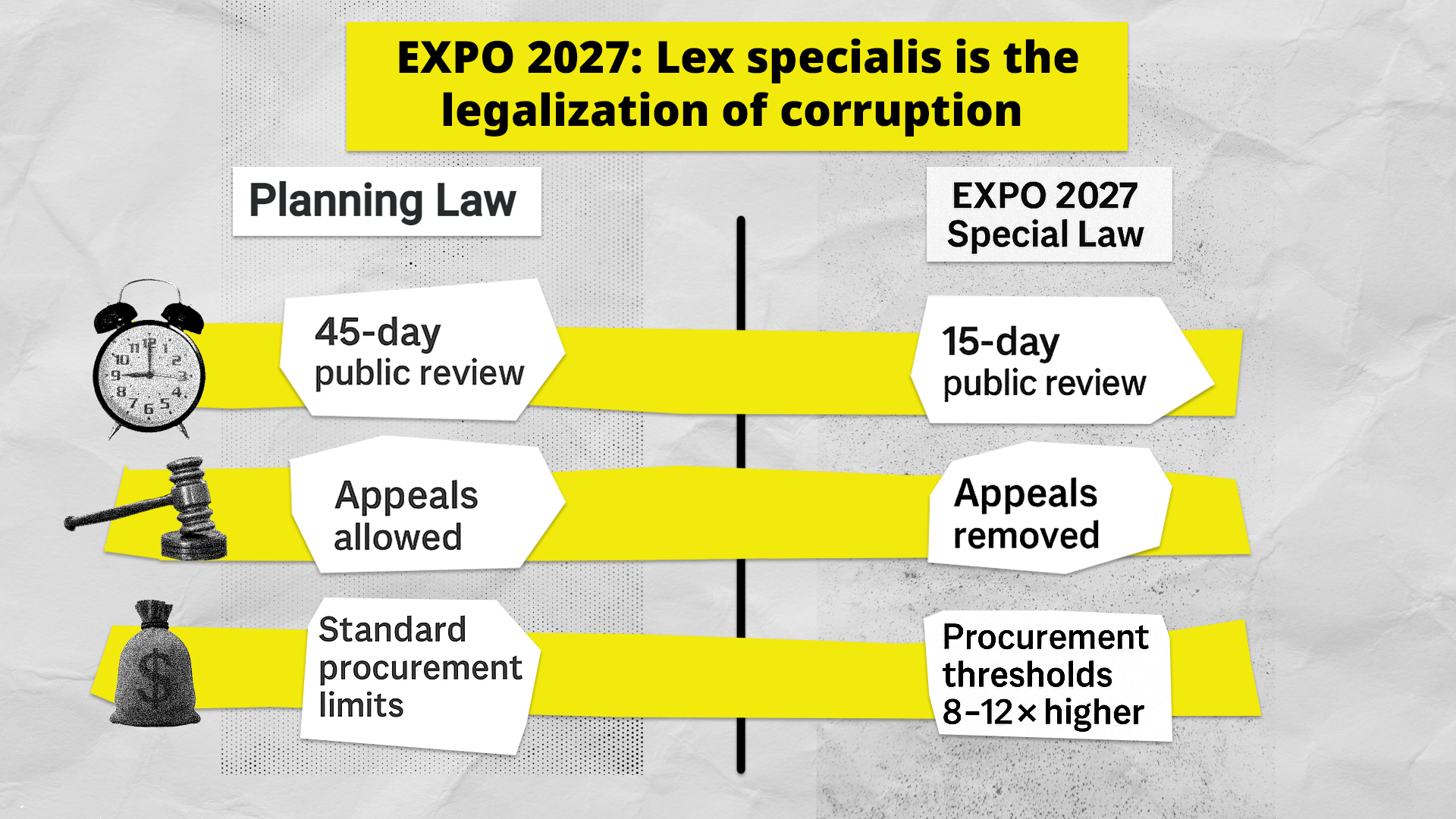
For the purposes of EXPO 2027, the government has adopted a special law that allows large public projects to be carried out outside the standard public procurement system.
This means that billions of euros of public money can be spent under a special legal regime.
Serbian lex specialis remains fundamentally incomparable to those of the Paris Olympics or the Osaka World Expo, as the latter serve as temporary, project-specific frameworks for global events, whereas the Serbian model is a permanent circumvention of standard legal and urban planning protections, far beyond the scope of the Expo project.
How does this work?
The state establishes special companies (these companies act as investors for EXPO projects)
- EXPO 2027: Costs and Corruption
- Entities awarded substantial contracts without public tender procedures
These companies are not subject to the Public Procurement Law
This means they are not required to conduct standard tenders, a rigorous and regulated process that ensures taxpayers’ money is spent transparently and efficiently.
The government adopts special rules
Instead of being regulated by law, procedures are governed by government decrees.
The public has no insight into the processes
Legal oversight mechanisms are significantly weakened.
How much money is involved?
Estimates suggest that 17.8 billion euros of public funds will be spent within EXPO projects.
For more information on financial aspects, see here.
Legal Engineering Beyond EXPO 2027: The Age of Prevailing lex specialis
The increasing practice of using lex specialis mechanisms in Serbia to overrule existing legislation is raising further alarms about the credibility and intentions behind the EXPO lex specialis. In this context, note the well-publicised Mrdic Laws being reviewed by the Venice Commission, and the controversial case of the General Staff Building, which resulted in a legal process against an acting minister. Special laws have proliferated to such an extent that researchers characterise the current period as an “age of prevailing of spatial plans for special purpose areas”.
The “Fait Accompli” Loophole: Prosecution Ignoring Illegal Construction
On June 18th 2025, RERI filed a criminal lawsuit against Finance Minister Siniša Mali for building the aboveground structure without a permit. Concrete columns were actively rising from the site, even though the investor only possessed a Phase I permit strictly limited to preparatory, underground and foundation works.
On August 20th, 2025, the Ministry of Construction formally issued a decision to reject the Ministry of Finance’s application for the Phase II building permit due to incomplete technical documentation. This rejection officially confirmed that the aboveground structures clearly visible throughout the summer were illegal.
RERI submitted an urgent appeal demanding that the Public Prosecution immediately dispatch an independent construction expert to document the illegal construction. Yet, instead of acting on this documented crime in progress, the prosecution stalled. On September 10th, 2025, the Ministry of Construction finally approved the corrected Phase II permit. Days later, the prosecution dismissed RERI’s complaint, declaring it “irrelevant” because the investor now had a permit. By refusing to establish this basic chronological timeline on-site, the judicial system deliberately avoids documenting the evidence of a completed crime.
Unfortunately, this is not a precedent in Serbia, but a pattern. In its April 2026 report on Serbia, the UN Working Group on Business and Human Rightsexplicitly condemned the practice of allowing strategic projects to proceed “without all the required permits reflecting significant gaps in state inspection and monitoring.”
- UN Working Group Report, Page 13, Paragraph 113